
The three most common HOA board member mistakes are policing people instead of managing property, communicating and documenting too little, and trying to do every job yourself. All three are easy to fall into and easy to avoid once you know to watch for them.
Board members are usually volunteers, and most arrive with little or no experience running an association. The job is bigger than it looks from the outside. The board enforces the governing documents, maintains the common areas, manages the budget and the owners’ money, keeps the association’s records, and is often the first place residents turn in an emergency. If you are new, our article on an HOA board member’s responsibilities lays out the full list. With that much to learn, some missteps are inevitable. These three are the ones you can skip.

Share this infographic: Pinterest · Facebook · LinkedIn · Email · Download
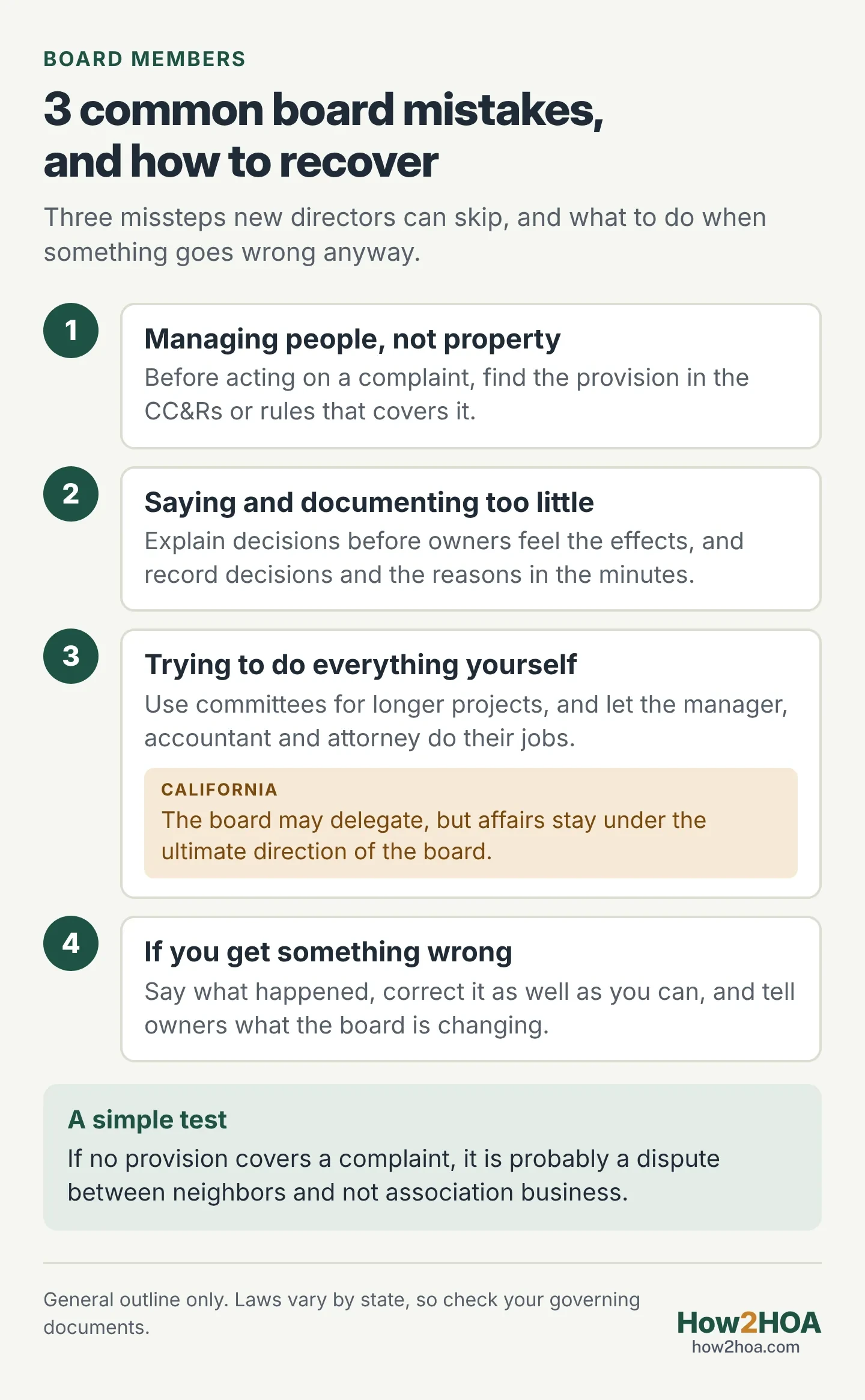
Mistake 1: Managing People Instead of Property
An association exists to maintain shared property and to enforce the covenants every owner agreed to when buying in. It does not exist to supervise how neighbors live. Some board members lose sight of that once they have a title. They start reaching for control over matters the governing documents never gave the board, such as where the neighborhood children play or how often a resident has friends over.
The test is simple. Before the board acts on a complaint, find the provision in the CC&Rs or rules that covers it. If there is one, such as a noise or nuisance clause, a parking rule or an architectural standard, enforce it the same way for everyone and follow the notice and hearing steps your documents and state law require. If there is no provision, the matter is probably a dispute between neighbors and not association business. The board can suggest they talk to each other, but it should not invent a rule to settle a personal disagreement.
Staying with the written rules also protects you. A board that enforces what the documents say, consistently, is much harder to accuse of favoritism than one that acts on personal opinions about how people should behave. Our article on how to enforce the rules in your homeowners association walks through the formal steps.
Mistake 2: Communicating and Documenting Too Little
Money is the most common source of suspicion in an association, and silence makes it worse. When owners do not know why assessments went up, why one contractor was chosen over another, or what the board discussed last month, they tend to assume the worst. Most of these misunderstandings can be prevented with clear communication and good records.
Communication has to work in two directions: among the directors, and between the board and the owners.
- Tell owners about decisions before they feel the effects. Explain a rule change, a project or an assessment increase in plain language, and give the reason for it.
- Publish meeting dates and agendas, and make the minutes easy to find.
- Keep every director in the loop. A board member who learns about a decision from a neighbor will not trust the next one.
Documentation is the other half. Keep invoices and receipts for every expense, written bids for larger contracts, and before and after photos of repairs. Record board decisions in the minutes along with the reasons for them. Good records show owners where their money went, and they protect directors if a decision is questioned years later. See maintaining your HOA records for what to keep and how to store it.
Most board members want to do a good job. Being open about what the board is doing is the simplest way to make sure the owners can see that.
Mistake 3: Trying to Do Everything Yourself
One of the first things a new director learns is that it is impossible to please everyone. One of the next is that it is impossible to do everything. Directors who try tend to burn out.
When owners are pressing the board to act on an issue, consider forming a committee and inviting the people who are asking for change to serve on it. Taking part in the work has three benefits:
- It shows them that getting things done in an association is rarely as simple as it looks from the audience.
- It gives more owners a stake in the outcome.
- It takes some of the workload off the board and spreads it among other volunteers.
Committees slow things down, so they are a poor fit for decisions that have to be made quickly. For longer projects that need research and bids, such as a playground replacement or a landscaping redesign, they are a good way to bring more people into the decision. A committee needs a clear assignment, a deadline and a director to report to. Our article on how to set up and run HOA committees explains how to give it all three.
Delegating also means using the professionals the association pays for. Let the manager handle daily operations, the accountant handle the books and the attorney handle legal questions. The board’s job is to give direction and check the results. Remember that the board stays responsible for whatever it delegates, so ask for regular reports and read them.
In California
California’s Davis-Stirling Act turns some of this advice into requirements. These are the points that relate most closely to the three mistakes above:
- Discipline has a required process and a fine cap. Before the board meets to consider discipline, Civil Code section 5855 requires written notice to the member at least 10 days ahead, a chance for the member to address the board, and an opportunity to cure the violation before the meeting. Under Civil Code section 5850, as amended effective June 30, 2025, a monetary penalty may not exceed the lesser of the amount in the association’s published schedule or $100 per violation, unless the board makes a written finding at an open meeting that the violation may result in an adverse health or safety impact on the common area or another member’s property.
- Decisions belong in meetings. Under Civil Code section 4910, the board may not take action on an item of business outside a board meeting and may not conduct a meeting through a series of emails, except for an emergency meeting when every director consents in writing. Under section 4950, minutes, draft minutes or a summary of an open board meeting have to be available to members within 30 days.
- Delegation does not shift responsibility. Corporations Code section 7210 lets the board delegate management of the association’s activities to a person, a management company or a committee, but the association’s affairs must still be managed under the ultimate direction of the board.
How to Recover From HOA Board Member Mistakes
No one serves on a board for long without getting something wrong. When you do, do not make it worse by trying to hide it. Say what happened, correct it as well as you can, and tell the owners what the board is changing so that it does not happen again. Being open shows that the error was unintentional, and it earns goodwill that a cover-up never will. If the mistake could have legal or financial consequences, tell the association’s attorney or accountant early.
Learn from other people too. Talk to former directors in your community about what worked and what did not. Get to know board members in nearby associations and compare notes. Their experience can save you from repeating their mistakes. You will find more articles for directors in our HOA board member section.
The Law Behind This Article
Every legal point in this article comes from the official text. Each link below opens it in a new tab.
Civil Code sections: 4910 · 4950 · 5850 · 5855
Corporations Code sections: 7210
This article is general educational information, not legal or financial advice. Laws vary by state and your association’s governing documents control many of these questions, so check with your association’s attorney or another qualified professional about your situation.