
An association can collect late HOA fees through foreclosure in most states. Once it holds a valid lien for unpaid assessments, it can ask a court to order the property sold (judicial foreclosure) or, where state law and the governing documents allow, have a trustee sell it without a lawsuit (nonjudicial foreclosure). HOA foreclosure is the most serious collection tool a board has. The rules are strict and state-specific, and the association’s attorney should run every step.
Foreclosure is the last of the enforcement options, and the most serious. It requires a recorded lien, and most boards reach it only after weighing the alternatives compared in What Are HOA Lien Options?, including small claims court and a court money judgment.
When HOA foreclosure is an option
Most delinquent accounts are resolved with a notice or a payment plan. Some are not paid until the board takes serious action, and for those the usual path is a lien followed, if necessary, by foreclosure. Foreclosure of an assessment lien works much like a mortgage foreclosure: the association forces a sale of the property to pay the debt. The power comes from state law and is usually spelled out in the declaration of covenants, conditions and restrictions (CC&Rs) as well. A mortgage on the property does not prevent the association from foreclosing, although it affects what the association will recover, as explained below.
Not every assessment debt can be foreclosed. Many states set conditions, such as a minimum amount owed, a minimum time the debt has been delinquent, or both. Know your state’s threshold before you spend money on a route that is not yet open. An account that is too small or too new today may qualify later if the owner keeps missing payments.
In practice, starting the process often ends it. When an owner receives formal notice that the board has voted to foreclose, the owner frequently pays, refinances or agrees to a payment plan before any sale takes place. That is a good outcome. The goal is to collect what the community is owed, not to take a neighbor’s home.
Types of foreclosure: judicial and nonjudicial
Judicial foreclosure
In a judicial foreclosure, the association files a lawsuit asking a judge to order the property sold to satisfy the lien. The owner can oppose the case, and the judge decides. This route takes longer and costs more. The association needs its attorney to prepare the case and answer the owner’s arguments, and the association can still lose if the judge finds a defect in the debt, the notices or the lien. The advantages are that a court has reviewed the process before any sale, and that in some states a judicial case can also produce a personal judgment against the owner.
Nonjudicial foreclosure
A nonjudicial foreclosure, also called a trustee’s sale, takes place without a court order. A trustee, often a trustee company or an attorney, is appointed to give the notices the law requires and then sell the property at a public sale. Not every state allows associations to use it. Where it is allowed, associations often prefer it because it is usually quicker and cheaper. The owner can still go to court to try to stop the sale or to challenge it afterward, and a sale that did not follow the statute exactly can be set aside.
The HOA foreclosure process, step by step
The details and deadlines come from state law, but the sequence generally looks like this:
- Attorney review. The attorney confirms that the lien is valid, the ledger is accurate, every earlier notice was sent correctly, the debt meets any state threshold, and the owner is not in bankruptcy.
- Board vote. The board votes on whether to start foreclosure on that specific property, and whether it will be judicial or nonjudicial. Treat this as a board decision, not one for a manager or collection vendor.
- Notice to the owner. The association notifies the owner of the board’s decision in the way state law requires. States differ on what must be sent, how it must be delivered and when. Follow the procedure exactly. An owner who was not properly notified can raise that with a judge, and a defect in the notice can undo the whole process.
- The foreclosure itself. In a judicial foreclosure the attorney files and serves the lawsuit. In a nonjudicial foreclosure the trustee records and serves the required notices and waits out the statutory periods.
- Sale. If the owner has not paid or settled, the property is sold at a public sale. In some states the owner then has a period in which to redeem the property by paying what is owed.
- Release. Whether the debt is paid through a sale or a settlement, the association records a release of its lien once it has been paid.
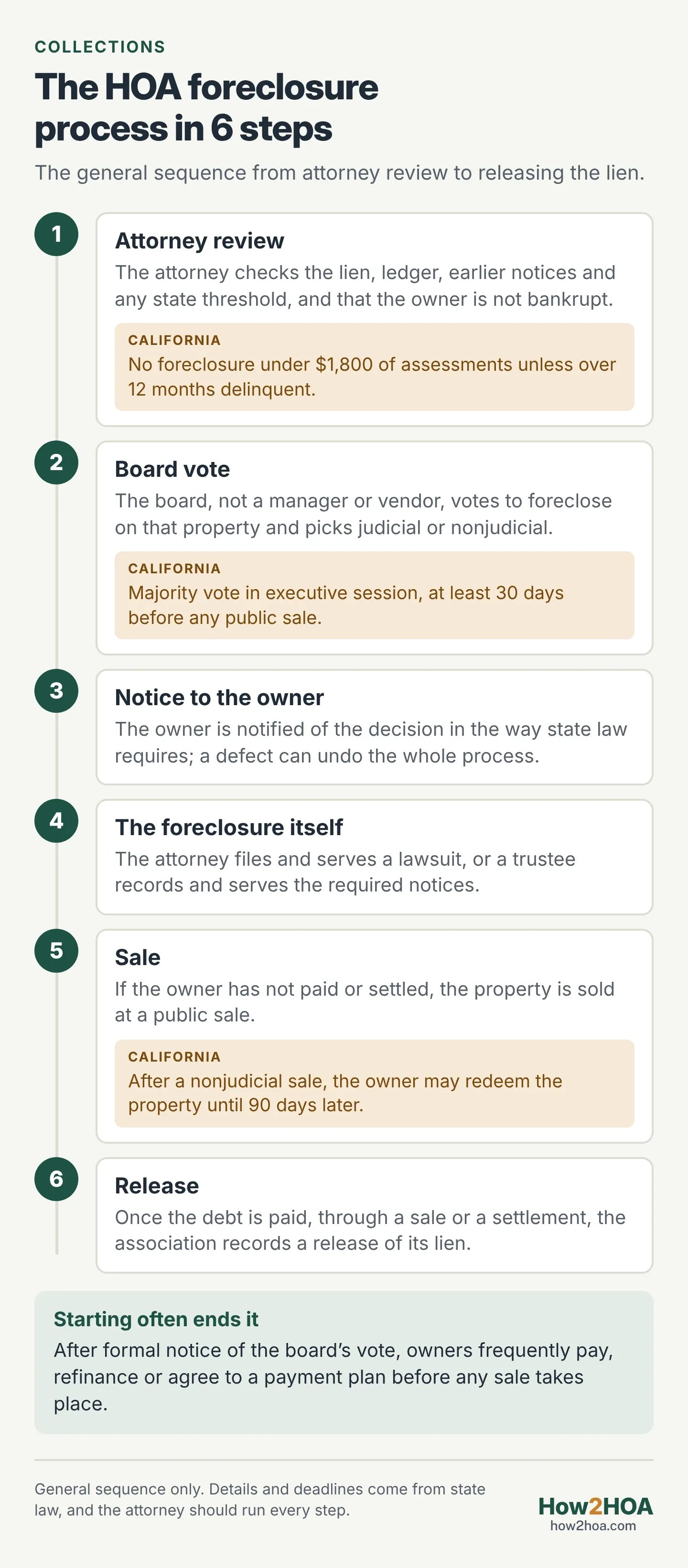
Share this infographic: Pinterest · Facebook · LinkedIn · Email · Download

What the association can expect to recover
Boards sometimes assume that foreclosing puts the association first in line for the sale proceeds. Usually it does not. Liens are ranked by priority. Property taxes generally come first, and a first mortgage is usually senior to the association’s lien. As a general rule, when a junior lienholder forecloses, the senior liens are not wiped out, and the buyer at the sale takes the property subject to them.
That has practical consequences. If the home is worth less than the mortgage balance, outside bidders have little reason to bid, and the association may end up owning a property that still carries the mortgage. If the home has equity above the senior debts, a sale is far more likely to pay the association in full. Some states give association liens a limited “super-priority” over the first mortgage, and the Federal Housing Finance Agency, as conservator of Fannie Mae and Freddie Mac, has stated that it will not consent to association foreclosures that would extinguish a Fannie Mae or Freddie Mac lien. Have the attorney explain where your lien ranks and estimate the likely recovery, net of legal and trustee costs, before the board votes.
In California: foreclosing an assessment lien
California allows both judicial and nonjudicial foreclosure of assessment liens, with safeguards for owners at each stage. This summary follows the current Davis-Stirling Act text, with each section linked in the sources section below.
- Minimum amount or age. An association may not use judicial or nonjudicial foreclosure to collect delinquent regular or special assessments of less than $1,800. That figure does not count accelerated assessments, late charges, collection fees and costs, attorney’s fees or interest. The limit does not apply once the assessments secured by the lien are more than 12 months delinquent, and it does not apply to assessments owed by time-share owners or by the developer (Civil Code section 5720).
- Thirty days after recording. A lien may be enforced, by judicial sale or by a trustee’s sale, only after 30 days have passed since the lien was recorded (Civil Code section 5700).
- Dispute resolution offer. Before starting foreclosure, the association must offer the owner dispute resolution, and must take part if the owner asks. The owner chooses between the association’s internal “meet and confer” program and alternative dispute resolution with a neutral third party. Binding arbitration is not available if the association intends to start a judicial foreclosure (Civil Code section 5705).
- Board vote in executive session. Only the board may decide to foreclose, and it may not delegate the decision to an agent. The board must approve it by a majority vote of the directors in executive session and record the vote in the minutes of the next meeting open to all members. To keep the owner’s identity confidential, the minutes must identify the matter by the property’s parcel number, not by the owner’s name. The vote must take place at least 30 days before any public sale (section 5705).
- Notice of the vote. If the board votes to foreclose, an owner who occupies the property, or the owner’s legal representative, must be given notice by personal service. An owner who does not occupy the property must be sent written notice by first-class mail at the most current address in the association’s records (section 5705).
- Trustee’s sale procedure. A nonjudicial sale must follow Civil Code sections 2924, 2924b and 2924c, the same sections that govern sales under mortgages and deeds of trust. In addition, the association must serve the notice of default on the owner in the manner required for serving a summons, and the trustee’s fees are capped (Civil Code section 5710).
- Right of redemption. A nonjudicial foreclosure by an association is subject to a right of redemption. The owner may redeem the property until 90 days after the sale, and the notice of sale must say so (Civil Code section 5715).
- No foreclosure for fines. A fine imposed as discipline may not be treated as an assessment that can become a lien enforceable by sale. A charge for repairing common area damage caused by a member, guest or tenant can be, but only if the governing documents provide for it (Civil Code section 5725).
- Priority. The association’s lien is prior to liens recorded after the notice of delinquent assessment, unless the declaration subordinates it to other liens and encumbrances (Civil Code section 5680).
- Release. Within 21 days after the owner pays the sums in the notice of delinquent assessment, the association must record a release and give the owner a copy (Civil Code section 5685).
These are summaries of long statutes, and the trustee’s sale sections add their own notices and waiting periods. A California board should not start a foreclosure without its attorney. Our overview of the Davis-Stirling Act explains how the statute is organized.
Alternatives to weigh before the board votes
Foreclosure is not the only way to collect on a lien, and it is not always the best one. The board can leave the lien in place and wait for a sale or refinance, accept a payment plan, sue the owner for a money judgment, or use small claims court for a smaller balance. Ask the attorney to compare the cost and likely recovery of each for the specific account. For more on association finances, visit our HOA finances section.
The Law Behind This Article
Every legal point in this article comes from the official text. Each link below opens it in a new tab.
Civil Code sections: 5680 · 5685 · 5700 · 5705 · 5710 · 5715 · 5720 · 5725
Other sources: FHFA: Statement on HOA Super-Priority Lien Foreclosures
This article is general educational information, not legal or financial advice. Laws vary by state and your association’s governing documents control many of these questions, so check with your association’s attorney or another qualified professional about your situation.