
SB 326 requires California condominium associations to have a licensed structural engineer, civil engineer or architect inspect a random, statistically significant sample of the wood-supported balconies, decks, stairways and walkways the association is responsible for, at least once every nine years. The first inspection was due by January 1, 2025. As of October 2026 that date has not been extended, so an association that has not completed one is past due. The requirement is codified in Civil Code section 5551, and this article is specific to California.
Which associations and which elements are covered
Civil Code section 5551 applies to the association of a condominium project, and only to buildings containing three or more attached multifamily dwelling units. It covers “exterior elevated elements,” which the statute defines as load-bearing components together with their associated waterproofing systems. A component counts only if all of the following are true:
- It extends beyond the exterior walls of the building. It delivers structural loads to the building from decks, balconies, stairways, walkways and their railings.
- It is elevated. The walking surface is more than six feet above ground level.
- It is built for people. It is designed for human occupancy or use.
- It relies on wood. It is supported in whole or in substantial part by wood or wood-based products.
The waterproofing system means the flashings, membranes, coatings and sealants that protect those components from water.
One more filter matters: the inspection covers only elements for which the association has maintenance or repair responsibility. That depends on your CC&Rs (covenants, conditions and restrictions). Under the default rule in Civil Code section 4775, an owner maintains the exclusive use common area attached to the unit, such as a balcony, and the association repairs and replaces it, unless the declaration says otherwise. If you are not sure whether your buildings or balconies fall under the statute, ask the association’s attorney and an engineer before assuming you are exempt.
Who may perform the inspection
The inspection must be conducted by a licensed structural engineer, civil engineer or architect. Civil engineers were added in 2024 by Assembly Bill 2114, an urgency measure that took effect on July 15, 2024, because associations were having trouble finding inspectors. General contractors and building inspectors are not on the list for condominium associations, although they can qualify under the separate apartment law described below.
What the inspection involves
- A visual inspection. The statute defines this as the least intrusive method necessary to inspect the load-bearing components, which can include moisture meters, borescopes or infrared technology.
- A statistically significant sample. Enough elements must be inspected to give 95 percent confidence that the results reflect the whole, with a margin of error of no more than plus or minus 5 percent.
- A random list. Before the first inspection, the inspector generates a random list of locations for each type of exterior elevated element, covering all the elements the association is responsible for. The association keeps the list. Each later inspection picks up with the next location on it.
- Further inspection where needed. If the inspector sees signs that water has gotten past the waterproofing in a way that could damage load-bearing components, the inspector may investigate further and uses professional judgment to decide how far.
The purpose is to determine whether the elements are in a generally safe condition and performing in accordance with applicable standards.
What the report must contain
The inspector issues a written report, stamps or signs it, presents it to the board, and it is incorporated into the association’s reserve study. The report must include:
- Identification of the building components that make up the load-bearing components and waterproofing systems.
- Their current physical condition, including whether it presents an immediate threat to the health and safety of residents.
- Their expected future performance and remaining useful life.
- Recommendations for any necessary repair or replacement.
- A first-page summary showing the inspection date, the number of units in the project, the number of units with exterior elevated elements, the total number of such elements, how many were inspected, how many were identified as an immediate safety threat and how many units that affects, and the inspector’s certification that a statistically significant sample was evaluated.
The association must keep the reports for two inspection cycles. Inspector’s reports are listed as association records in Civil Code section 5200, so members may ask to see them, and under section 5210 they stay open to inspection for that full two-cycle period rather than the usual current year plus the two before it. And since January 1, 2026, Civil Code section 4525 requires an owner who is selling to give the buyer a copy of the report from the most recent inspection, a change made by Senate Bill 410. Expect escrow and lenders to ask for it.
Deadlines and the nine-year cycle
- First inspection. Due by January 1, 2025.
- Repeat inspections. Every nine years after that, coordinated with the reserve study inspection required by Civil Code section 5550. Because reserve study site inspections happen at least every three years, the balcony inspection lines up with every third one.
- Newer buildings. For a building whose building permit application was submitted on or after January 1, 2020, the inspection must occur no later than six years after the certificate of occupancy was issued.
Was the deadline extended?
Not for condominium associations, based on the statute text we reviewed in October 2026. A 2024 bill, Assembly Bill 2579, extended the first-inspection deadline for apartment buildings under the companion law to January 1, 2026. It did not change section 5551. Section 5551 does not itself set out a fine for a late inspection, but that is not much comfort. An association that has skipped a mandatory safety inspection is exposed if someone is hurt, may face questions from its insurer and from lenders, and has no report for sellers to hand to buyers. If your association is late, the practical answer is to hire an inspector now and document the board’s steps.
If the inspector finds an immediate threat
When the inspector advises that an element poses an immediate threat to the safety of occupants, three things are required by statute:
- The inspector gives the association a copy of the report immediately upon completing it.
- The inspector gives a copy to the local code enforcement agency within 15 days of completing the report.
- The association takes preventive measures immediately, including preventing occupant access to the element until repairs have been inspected and approved by the local enforcement agency.
Local enforcement agencies may recover their enforcement costs from the association. Cities and counties, and the board itself, may also adopt requirements stricter than the statute.
Paying for the inspection and the repairs
The association is responsible for complying with section 5551 and, as its governing documents provide, for keeping these components in a safe, functional and sanitary condition. The inspection is an operating or reserve expense that should be budgeted. Repairs are harder, because they can be large and urgent.
- Reserves. Once the report is folded into the reserve study, the remaining useful life and repair cost estimates drive the funding plan.
- A special assessment. The board can levy up to 5 percent of budgeted gross expenses without a member vote, and the emergency exception may apply to a health or safety threat.
- A loan. Borrowing spreads the cost over several years. Compare the two in HOA loan vs. special assessment.
- Claims against the builder. In newer buildings, defects found during the inspection may support a construction defect claim. SB 326 also added Civil Code section 5986, which generally prevents governing documents from requiring a member vote or developer consent before the board pursues such claims. Time limits apply, so talk to counsel promptly.
Who ultimately bears the cost of a particular balcony repair depends on the CC&Rs. Our guide to who pays for repairs in an HOA explains how to read them.
SB 326 compared with SB 721
SB 721 is the companion law for apartment buildings. It is found in Health and Safety Code section 17973 and does not apply to common interest developments.
| SB 326 (condominium associations) | SB 721 (apartments) | |
|---|---|---|
| Statute | Civil Code section 5551 | Health and Safety Code section 17973 |
| Who inspects | Licensed structural engineer, civil engineer or architect | Licensed architect, civil or structural engineer, certain licensed contractors with at least five years of experience, or a certified building inspector |
| Sample | Statistically significant random sample (95 percent confidence, plus or minus 5 percent) | At least 15 percent of each type of element |
| First deadline | January 1, 2025 | January 1, 2026 |
| Cycle | Every nine years | Every six years |
Practical steps for a board
The statute sets the minimum. The sequence below is good practice for meeting it without surprises.
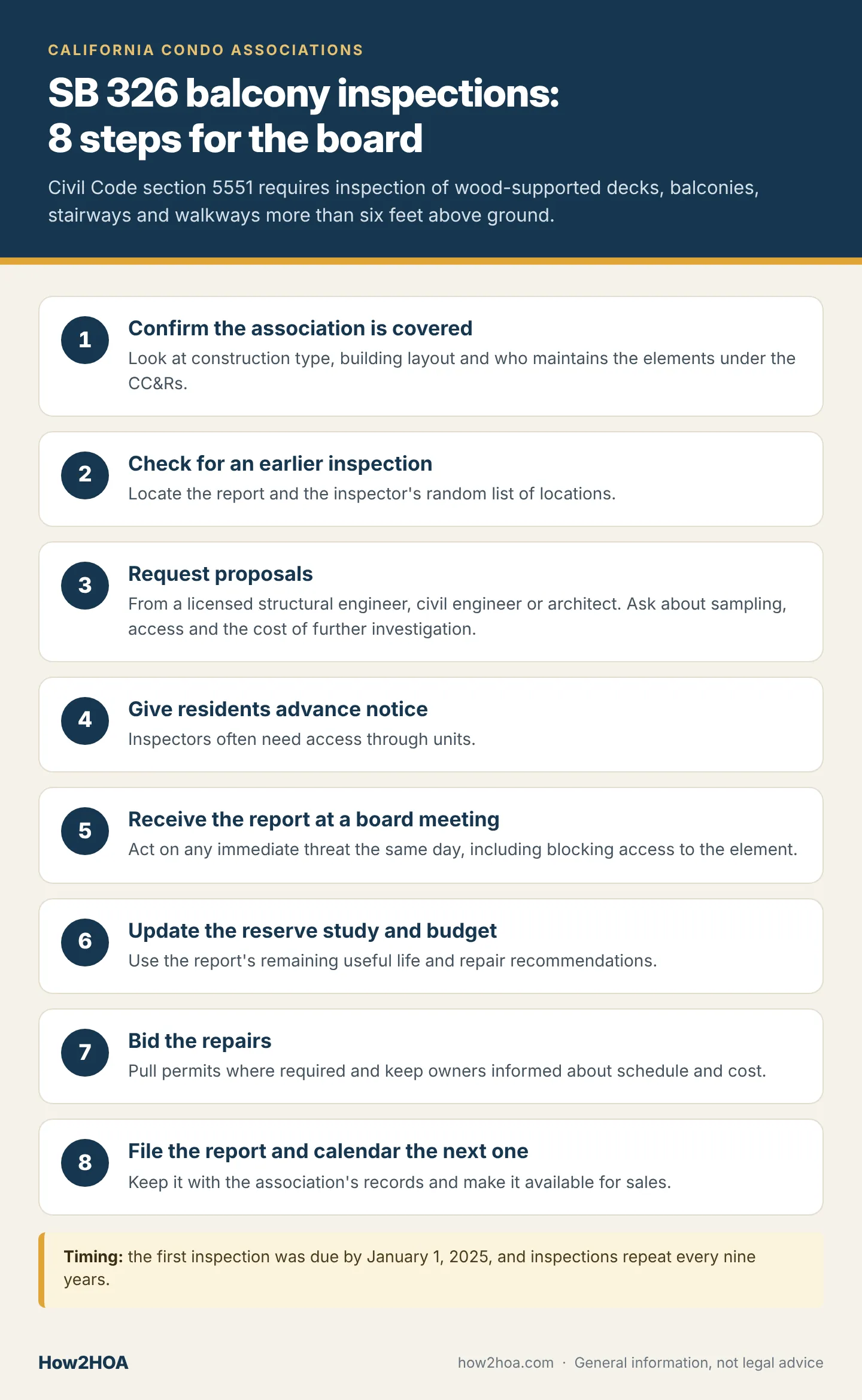
- Confirm whether the association is covered, looking at construction type, building layout and maintenance responsibility under the CC&Rs.
- Check whether an inspection has already been done, and locate the report and the random list.
- Request proposals from qualified engineers or architects. Ask about sampling method, access needs, the cost of further investigation if moisture is found, and timing. Our guide to hiring a contractor covers vetting and contracts.
- Give residents advance notice, since inspectors often need access through units.
- Receive the report at a board meeting and act on any immediate threat the same day.
- Update the reserve study and the budget to reflect the findings.
- Bid the repairs, pull permits where required, and keep owners informed about schedule and cost.
- File the report with the association’s records, make it available for sales, and calendar the next inspection.

Share this infographic: Pinterest · Facebook · LinkedIn · Email · Download
For related guidance, visit the maintenance and vendors hub. Boards that want help coordinating inspections and repairs can also review their management options.
The Law Behind This Article
Every legal point in this article comes from the official text. Each link below opens it in a new tab.
Civil Code sections: 4525 · 4775 · 5200 · 5210 · 5550 · 5551 · 5605 · 5610 · 5986
Health and Safety Code sections: 17973
This article is general educational information, not legal or financial advice. Laws vary by state and your association’s governing documents control many of these questions, so check with your association’s attorney or another qualified professional about your situation.