
To sell a house in an HOA, you follow the normal sale process and add a few association steps. You order the association’s resale documents for the buyer, clear up any unpaid assessments and open violations, and plan for the association’s fees at closing. In most places you do not need the HOA’s permission to sell, but its documents and its statement of your account are part of the transaction, so start on them early.
The steps below describe general practice. The exact documents, deadlines and fees depend on your state’s law and your governing documents, and there is a California section further down. This article covers the process. For the selling points of a well-run community, see the benefits of selling a home with an HOA.
Getting Prepared to Sell a House in an HOA
Say you have decided it is time to go. You have enjoyed the neighborhood, but you have always wanted to buy an RV and see the country, and now the RV is in the driveway. Before the listing goes live, spend an hour on the association side of the sale. You usually do not have to tell the HOA before you list, but there are rules to follow and documents only the association can produce, and you do not want either one holding up your closing.
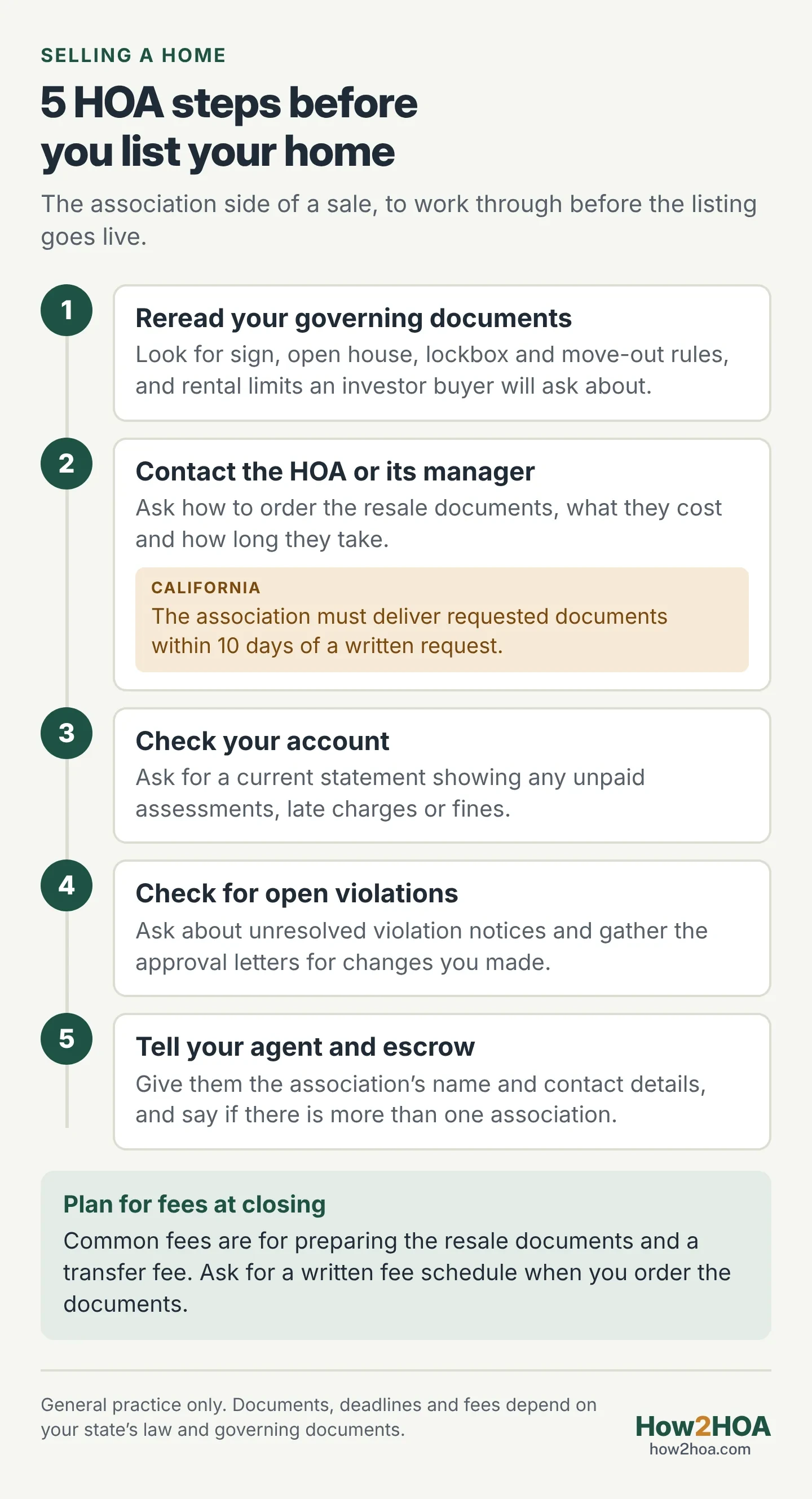
- Reread your governing documents. Look in the CC&Rs and rules for anything that touches a sale: sign rules, open house or lockbox rules, move-out rules, rental limits that an investor buyer will ask about, and in a few older communities a right of first refusal. Our article on governing documents explains where each kind of rule lives.
- Contact the association or its management company. Ask how to order the resale documents, what they cost and how long they take. Depending on the state, the package is called a resale certificate, a disclosure packet or an estoppel certificate.
- Check your account. Ask for a current statement showing any unpaid assessments, late charges or fines.
- Check for open violations. Ask whether the association has any unresolved violation notices on file for your home, and gather the approval letters for changes you made.
- Tell your agent and your escrow or title officer. Give them the association’s name and contact details, and tell them if there is more than one association, such as a master association and a sub-association.

Share this infographic: Pinterest · Facebook · LinkedIn · Email · Download
It also helps to find someone who knows the process. If your association has no management company, a board member can tell you who prepares the documents and where to send the request. A neighbor who sold recently can tell you how long the paperwork really took. Neither one decides anything about your sale, but both can save you a few phone calls.
You, the HOA and the Buyer
Three parties have a stake in an HOA sale. You want to close. The buyer wants to know what they are joining. The association wants its account settled and its records updated. Here is how those interests come together.
Settle What You Owe
Unpaid assessments do not stop you from listing your home, but they have to be dealt with by closing. The association’s statement shows what is owed, and escrow normally pays it from your sale proceeds. If the association has recorded a lien, the title company will require it to be paid and released before the buyer takes title. Paying early stops late charges and interest from growing and removes a surprise from your closing statement.
Resolve Violations and Unapproved Changes
An open violation, such as an exterior paint color the association never approved, usually does not block a sale by law. Your state’s disclosure rules may require you to tell the buyer about it, as California’s do, and buyers tend to ask for a repair or a credit when they see one. Fix what you can before you list. If you made a change without approval, ask the association whether it will approve it after the fact, and keep every approval letter to hand to the buyer.
Plan for Fees at Closing
Many owners are surprised by the association’s fees at closing. The most common are a fee for preparing the resale documents and a transfer fee for updating the ownership records. Some communities also collect a one-time contribution to the association’s funds, or a fee based on the sale price, where state law and the governing documents allow it. Who pays each fee depends on state law, the purchase contract and local custom. Ask for a written fee schedule when you order the documents.
Give the Buyer the Documents
Expect to hand the buyer a stack of association paperwork. The exact list is set by state law, but it usually includes:
- The CC&Rs, bylaws and rules, including any special restrictions on the property
- The current assessment amount and what it covers
- A statement of anything you owe the association
- Any special assessment or dues increase that is approved or planned
- The current budget, recent financial statements and the reserve study
- A summary of the association’s master insurance policy
- Any unresolved violation notice
- Approval letters for changes you made to the home
- Recent board meeting minutes, often on request
Buyers read these documents closely. Our overview of what to know before you buy in an HOA shows what they look for. If you are selling a condominium, the buyer’s lender may also send the association a questionnaire about its finances, insurance and litigation. Your mortgage and the HOA explains why, and why a slow answer can delay closing.
In California
California spells out the seller’s duties in the Davis-Stirling Act.
- What you must provide. As soon as practicable before title transfers or a sales contract is signed, the seller must give the prospective buyer a set of items that includes the governing documents, the association’s most recent annual budget report and related disclosures, a written statement from the association of current assessments and of any unpaid assessments, fines and charges on the seller’s account, any unresolved violation notice, approved assessment changes that are not yet due, a description of any rental prohibition, and the report from the most recent inspection of exterior elevated elements such as balconies. If the buyer asks, the seller must also provide the board’s approved minutes for the past 12 months (Civil Code 4525).
- What the association must do. The association must deliver the documents you request within 10 days of the mailing or delivery of your written request. It may charge a reasonable fee based on its actual cost, with no extra charge for electronic delivery. On written request it must give you a fee estimate on the statutory form before it processes the order. It may not bundle these documents with others. Current copies you already have go to the buyer at no cost, so you are not required to buy every document from the association (Civil Code 4530; the form is in Civil Code 4528).
- Transfer fees are limited. An association may not charge a fee on a transfer of title beyond its actual cost to change its records and the document fees that section 4530 allows (Civil Code 4575). A narrow exception covers certain older community service organizations and similar nonprofit entities (Civil Code 4580).
- For-sale signs. Restrictions in deeds and similar instruments that bar an owner from displaying a for-sale sign of reasonable size and design, reasonably located on the owner’s property, are void (Civil Code 712). Check your association’s sign rules for size and placement, especially in a condominium where the grounds are common area.
Before You Hand Over the Keys
Selling a home takes work no matter how you do it, and an HOA does not add much if you start early. In the last week before closing, a few small tasks finish the job:
- Confirm with escrow that the association’s final statement has arrived and that the amounts match your records.
- Cancel any automatic dues payment for the period after closing.
- Leave the buyer the gate remotes, pool keys, parking passes and mailbox keys that belong to the home.
- Give the association a forwarding address in case of a final statement or refund.
Keep your records organized, talk to the association early, and the HOA part of your sale should be routine. You can find more articles for owners in our section on living in an HOA.
The Law Behind This Article
Every legal point in this article comes from the official text. Each link below opens it in a new tab.
Civil Code sections: 712 · 4525 · 4528 · 4530 · 4575 · 4580
This article is general educational information, not legal or financial advice. Laws vary by state and your association’s governing documents control many of these questions, so check with your association’s attorney or another qualified professional about your situation.