
The safest way to handle electrical work in a community is to keep a licensed, insured HOA electrical contractor under a written contract, so the board knows who to call, what a visit costs and how fast help will arrive. Before hiring, confirm the license and insurance yourself, compare at least three bids on the same scope, and have the association’s attorney review the agreement.
Whatever the size of your community, the association depends on electricity. Streetlights, entry gates, security systems, landscape and pathway lighting, pool equipment, elevators and clubhouse systems all stop working when the power does. Larger communities with more facilities have more to maintain. Many owners buy into an HOA because they want a safe, well-lit neighborhood, and a dark parking lot or a gate stuck open undercuts that quickly.
How an Electrical Contractor Helps
Because an association’s electrical needs are ongoing, many communities keep one company on contract instead of calling a different electrician each time something fails. The contractor learns the property, responds to outages and repairs, and handles routine maintenance on the systems the association is responsible for. Regular inspections on a set schedule, with the frequency matched to the size and age of the systems, catch failing fixtures, damaged conduit and overloaded panels before they turn into outages.
Many electrical contractors can also help the board look at the bigger picture. They can evaluate where the association uses the most power and suggest ways to save, such as LED lighting, timers, photocells and controls, or solar. If the board wants to pursue an idea, the contractor can price it and help carry out the plan. Larger upgrades belong in the budget and the reserve plan, and may call for a special assessment if reserves fall short.
Hiring an HOA Electrical Contractor
The board wants the company that will give the best service for the community’s needs. It also has to think about liability, because electrical work is technical and dangerous when done badly. Start by making sure every bidder can produce the required documents:
- Liability insurance
- Workers’ compensation insurance
- A state license that covers electrical work
- The license bond your state requires
- A local business license, where one is required
- Permits for work that needs them
Check Licenses and Insurance Yourself
Licenses and insurance are easy to overlook and matter a great deal. The board should confirm the license independently with the state licensing agency instead of relying on the contractor’s word. In some states, an association that hires an unlicensed contractor can be treated as the employer of that contractor’s workers. If one of them is hurt on the job, the claim can fall on the association, whether or not the board knew the contractor was unlicensed.
Workers’ compensation coverage matters for the same reason. When a contractor’s employees are covered, an injured worker’s claim is normally handled through that system. When they are not, the association can face a claim it has to defend and may have to pay, and a large uninsured loss can end in a special assessment on the owners. Our article on workers’ compensation insurance for associations explains how the association’s own policy fits in.
Even a licensed contractor can let its insurance lapse. The simple protection is to get a current certificate of insurance, sent by the contractor’s insurance agent, before the vendor steps onto the property, and to ask for a new one each time the policy renews.
Comparing Electrical Companies
Once you have several companies that are licensed, insured and bonded, gather more detail. Try to compare at least three, even if the association has used one of them before, and make sure no board member has a conflict of interest with a company under consideration. The general steps are the same as in our article on how to hire a contractor.
Describe the association’s needs the same way to each company and ask each one the same questions. Our vendor comparison worksheet gives you one place to record the answers.
- What is your background in work for associations or similar properties?
- How do you hire, and what experience and training do the electricians assigned to us have? Did they complete apprenticeships in addition to classroom training?
- Which comparable projects or maintenance contracts have you handled recently, and can we call those clients?
- What warranty or guarantee do you give on labor and materials?
- How do you keep up with changes to the National Electrical Code (NEC) and to state and local electrical codes?
- How quickly do you respond to emergencies, and what do after-hours calls cost?
With the bids in hand, weigh your options. Price matters, and budget pressure can make the cheapest bid appealing, but choosing on price alone often leads to problems that cost more later. The most expensive bid does not guarantee the best work either. Weigh cost against experience and quality, check the references and make sure you understand every service each company is promising to provide.
What to Put in an Electrical Service Contract
For any vendor, and especially for electricians, use a written contract that the association’s attorney has reviewed. A contract protects the association and the contractor alike. The terms are settled before work begins, so there is no argument later about what was agreed verbally, and if the cost or the schedule changes you have a defined way to handle it.

Share this infographic: Pinterest · Facebook · LinkedIn · Email · Download
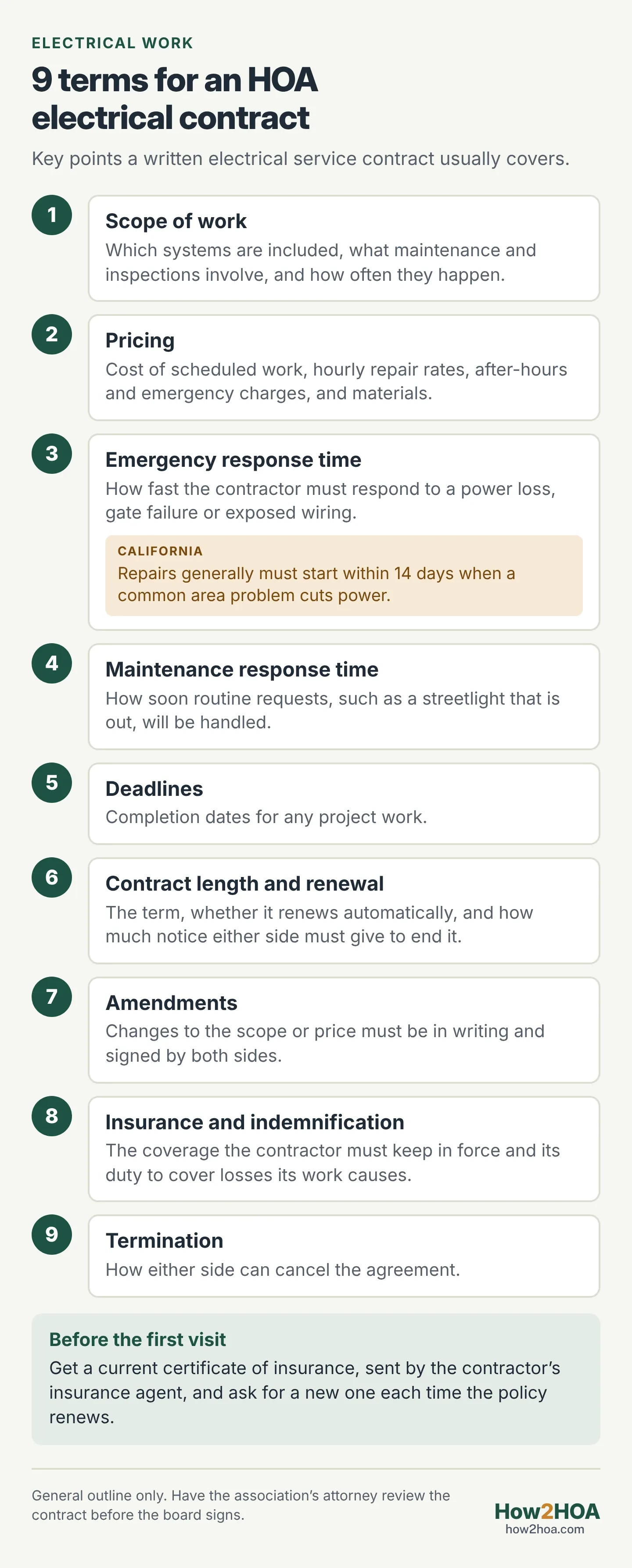
An electrical service contract usually covers:
- Scope of work. Which systems are included, what routine maintenance and inspections involve, and how often they happen.
- Pricing. The cost of scheduled work, hourly rates for repairs, charges for after-hours and emergency calls, and how materials are billed.
- Emergency response time. How fast the contractor must respond to an emergency such as a power loss, a gate failure or exposed wiring, and how to reach it after hours.
- Maintenance response time. How soon routine requests, such as a streetlight that is out, will be handled.
- Deadlines. Completion dates for any project work.
- Contract length and renewal. The term, whether it renews automatically and how much notice either side must give to end it.
- Amendments. A requirement that changes to the scope or price be in writing and signed by both sides.
- Insurance and indemnification. The coverage the contractor must keep in force and its obligation to cover losses its work causes.
- Termination. How either side can cancel the agreement.
After the contract is signed, the day-to-day work is managing the vendor: one point of contact, records of each visit and prompt payment.
In California
- The license classification. The Contractors State License Board (CSLB) licenses electrical contractors under the C-10 Electrical Contractor classification, which covers placing, installing, erecting or connecting electrical wires, fixtures, appliances, apparatus, raceways and conduits, and solar photovoltaic cells.
- When a license is required. CSLB states that it is illegal for an unlicensed person to work on a project valued at $1,000 or more in combined labor and material costs, or on any project that requires a building permit or uses employee labor.
- How to check. Search CSLB’s Check a License tool by license number, business name or personnel name, or call (800) 321-CSLB (2752). Confirm the license is active and includes C-10.
- Electrician certification. The Department of Industrial Relations requires electricians who work for a C-10 contractor to be certified. Ask the contractor to confirm that the electricians sent to your property hold the required certification.
- Insurance and bond. CSLB’s consumer guidance says a contractor with employees must carry workers’ compensation insurance, that commercial general liability insurance is not required for a license, and that the $25,000 contractor license bond may not cover a project worth more than the bond. Require liability coverage in your contract and ask to see the certificate of insurance.
- Unlicensed workers. Labor Code section 2750.5 presumes that a person doing work that requires a contractor’s license is an employee, and makes a valid license a condition of independent contractor status. That is the California version of the employer risk described above.
- Restoring service. Under Civil Code section 4775, unless the declaration says otherwise or a utility is responsible for the failed component, the association is responsible for repairs needed to restore electrical service that is interrupted by a problem beginning in the common area, and the board must start the repair process within 14 days of the interruption. Having a contractor already under contract makes that deadline much easier to meet.
For related articles, see our maintenance and vendors section.
The Law Behind This Article
Every legal point in this article comes from the official text. Each link below opens it in a new tab.
Civil Code sections: 4775
Labor Code sections: 2750.5
Other sources: CSLB: C-10 Electrical Contractor Classification · CSLB: What Is Illegal Contractor Activity? · DIR: Electrician Certification · CSLB: Finding the Right Contractor
This article is general educational information, not legal or insurance advice. Laws vary by state and your association’s governing documents control many of these questions, so check with your association’s attorney or another qualified professional about your situation.