
The most reliable ways to improve HOA curb appeal are to make a written plan, involve residents, choose landscaping that is easy to keep healthy, keep common areas clean and in good repair, and enforce the community’s rules fairly. A neighborhood that looks cared for is more pleasant to come home to and makes a better first impression on buyers and visitors. Below are five ways a board can get there without overspending.

Share this infographic: Pinterest · Facebook · LinkedIn · Email · Download
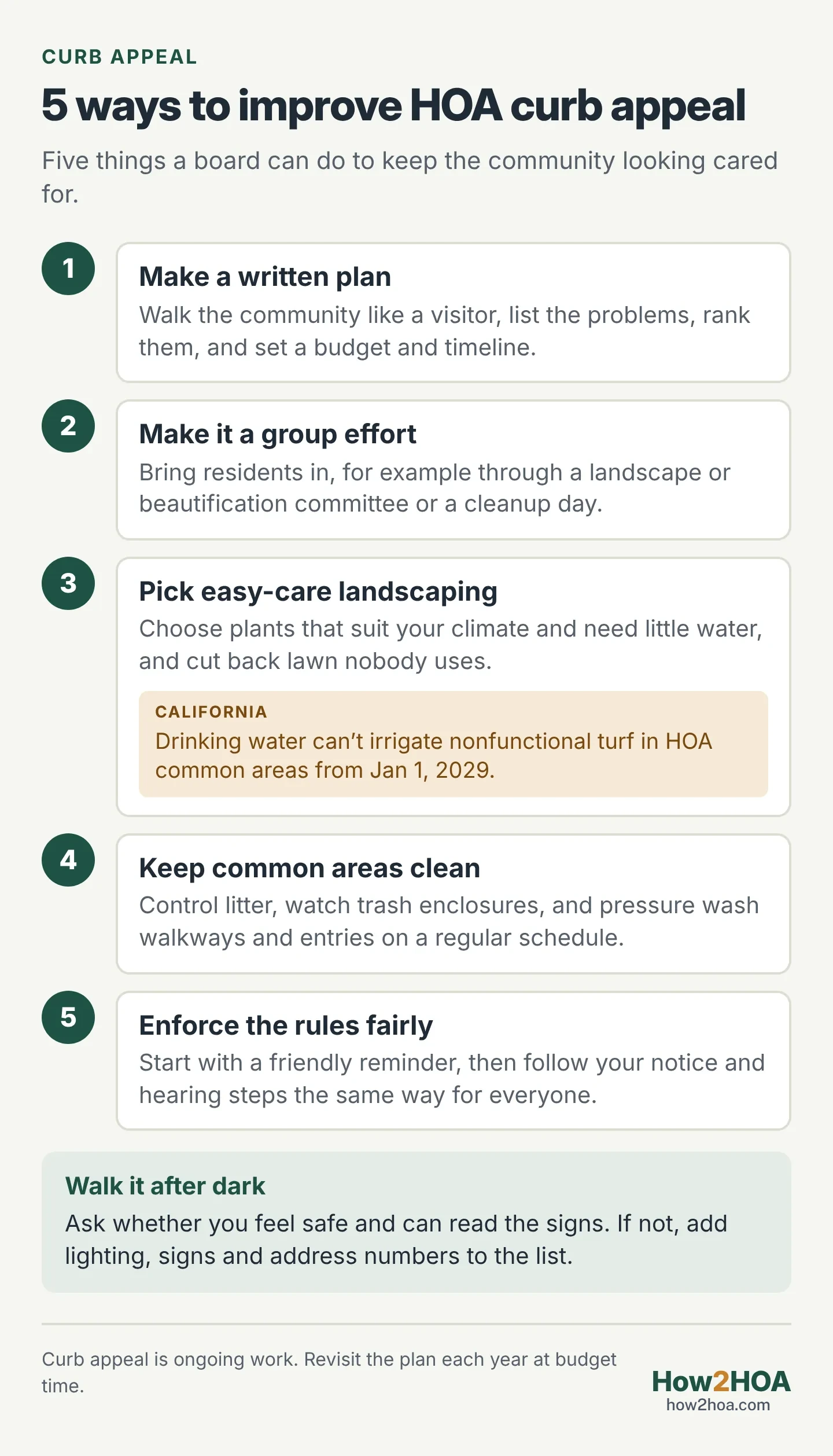
1. Make a Plan
Start by walking the community the way a visitor would, from the entrance to the common areas, and write down what you see. A plan that lists the problems, ranks them and assigns a budget and a timeline will save the board time and money compared with fixing things one complaint at a time. Planning together is also a good way to get the whole board working toward the same goals.
Landscaping is usually the biggest piece. Choose plants and materials that grow well in your climate and do not need constant attention, because nobody wants to spend the association’s budget on fussy plants that are hard to keep alive. Similarly, pick materials for signs, fences, benches and lighting that hold up to weather and are simple to clean, repair or repaint, so the community still looks good several years after the money is spent.
Include cleanliness in the plan. Regular trash pickup and periodic washing of walkways, walls and entry features show buyers and residents that the community is consistently maintained.
Finally, check that the neighborhood is easy to find your way around. If visitors cannot see building numbers or street signs, they will struggle to find an address, and so will delivery drivers and emergency responders. Good lighting helps with both appearance and safety. Walk the property after dark and ask whether you feel safe and can read the signs. If not, add lighting, signs and address numbers to the list.
2. Make HOA Curb Appeal a Group Effort
Know what you want from your curb appeal efforts, then bring residents into the process. People who help choose a planting scheme or organize a cleanup day take ownership of the result, and it takes some of the load off the board. A landscape or beautification committee is a common way to do this, and our article on setting up and running committees explains how to give one a clear job. Some communities also organize a Neighborhood Watch group, which gets more residents paying attention to the common areas and reporting problems such as broken lights, graffiti or dumping.
An architectural review committee has a similar effect. It does not need to be a heavy-handed group that counts the reindeer on every roof at the holidays. Its job is to see that changes owners propose for their homes follow the community’s architectural standards and that requests are handled consistently. Check your CC&Rs (covenants, conditions and restrictions) to confirm what authority the association has and what procedure it must follow before you set up a committee or adopt new standards.
3. Choose Landscaping That Is Easy to Maintain
For common areas, budget for ongoing maintenance as well as the initial installation. Landscaping is often one of the larger lines in an association’s operating budget, so it is worth looking for ways to reduce the cost when you are planning the budget.
Water is the place to start. Xeriscaping means designing with plants and materials that need little irrigation. It is common in the dry Southwest and in other climates where rain is scarce. The U.S. Environmental Protection Agency’s WaterSense landscaping tips recommend regionally appropriate, low-water and native plants, grouping plants with similar water needs, mulching to reduce evaporation, and keeping turf grass only where it has a practical use. Some communities also irrigate common areas with recycled water where the local water agency supplies it. Reusing greywater from buildings is regulated by state and local plumbing codes, so talk to your landscape contractor and the building department before planning around it.
If grassy areas are hard to keep up, reduce the amount of grass. Lawn that nobody uses can be replaced with planted beds, ground cover, mulch or gravel. Larger areas might be put to use as a sport court, a playground, a seating area or additional parking, subject to what your governing documents and local zoning allow. Where residents have worn a trail across the grass, build a path there. It protects the rest of the landscaping and gives people the route they have already chosen.
4. Keep Common Areas Clean
Keeping the community free of litter is an obvious way to raise curb appeal. Pay particular attention to trash enclosures, dumpsters and compactors, where mess builds up fastest. If those areas are neglected, residents and prospective buyers will assume the rest of the property is neglected too.
Have common elements such as walkways, entry monuments, mailbox areas and building exteriors pressure washed on a regular schedule. Dingy surfaces make a community look older and more worn than it is, and cleanliness is one of the first things a visitor or buyer notices.
Pavement matters as well. Fresh striping and timely repairs make streets and parking lots look cared for, and nobody wants to buy into a community full of potholes. Our article on pavement and asphalt management covers how to plan that work.
5. Enforce the Rules Fairly
Making sure owners follow the rules is never the fun part of serving on a board, but visible violations (trash cans left out, overgrown yards, vehicles stored on lawns) hurt the look of the neighborhood and can put off prospective buyers. When rules go unenforced, new owners may also conclude that they do not have to follow them.
Enforcement is a delicate matter. As a board member, your duty is to the community as a whole. Start with a friendly reminder, since most owners fix a problem once they know about it. If that fails, follow the notice and hearing steps in your governing documents and state law, and apply them the same way to every owner. Our article on how to enforce the rules covers formal notices, hearings and fines. A few people may be unhappy, but consistent and fair enforcement protects everyone else’s enjoyment of the community.
In California: Landscaping and Water Rules
California law affects both common area and owners’ landscaping choices.
- Low-water plants and artificial turf. Under Civil Code section 4735, a provision of the governing documents or of architectural or landscaping guidelines is void if it prohibits low water-using plants as a group or as a replacement for existing turf, or prohibits artificial turf or another synthetic surface that resembles grass.
- Drought emergencies. The same section bars an association from fining or assessing an owner for reducing or eliminating watering of plants or lawns during a drought emergency declared by the state or local government. An owner who installed water-efficient landscaping in response to the emergency cannot be required to remove it afterward. There is a narrow exception for owners who receive recycled water for irrigation and do not use it.
- Common area lawns. Water Code section 10608.14 phases in a ban on using drinking water to irrigate nonfunctional turf on certain properties, including HOA common areas. According to the State Water Resources Control Board, the ban applies to common areas of homeowners associations and common interest developments starting January 1, 2029. It does not apply to individual residential yards, to turf in recreational or community-use areas, or to watering trees and other non-grass plants. Associations with more than 5,000 square feet of irrigated common area must certify compliance beginning June 30, 2031.
If your community has decorative lawn that nobody walks or plays on, start planning and budgeting for its replacement now.
Curb appeal is ongoing work, not a one-time project. Revisit the plan each year at budget time and keep residents involved. For help with vendors and upkeep, see our maintenance and vendors section.
The Law Behind This Article
Every legal point in this article comes from the official text. Each link below opens it in a new tab.
Civil Code sections: 4735
Water Code sections: 10608.14
Other sources: EPA WaterSense: Landscaping tips · State Water Resources Control Board: Nonfunctional turf FAQs
This article is general educational information, not legal advice. Laws vary by state and your association’s governing documents control many of these questions, so check with your association’s attorney or another qualified professional about your situation.