
Good HOA asphalt maintenance comes down to a written plan: inspect the pavement regularly, fill cracks before water gets in, seal the surface on a schedule your paving contractor recommends, keep the striping visible and fund eventual resurfacing through the reserve study. Preventive work costs far less than rebuilding a failed road or parking lot, and it keeps the community safer in the meantime.
Most communities have asphalt somewhere: private streets, parking lots, driveways, bike and walking paths. Residents rarely think about pavement that is in good shape, but they notice a pothole right away, and pavement complaints tend to reach the board quickly. Asphalt is durable and can last a long time with good care. It still wears out. Sun and air dry out the asphalt binder, water works into cracks and traffic does the rest. Keeping pavement well maintained improves the look of the neighborhood and reduces the risk of trips, falls and vehicle damage that can become liability claims.
Preventive HOA Asphalt Maintenance
Preventing serious damage to roads and parking lots means fewer large repairs and fewer unhappy residents. The board should have a plan that fits the community’s pavement, traffic and climate. A paving professional can tailor one to your property, but most plans include the following.

Share this infographic: Pinterest · Facebook · LinkedIn · Email · Download
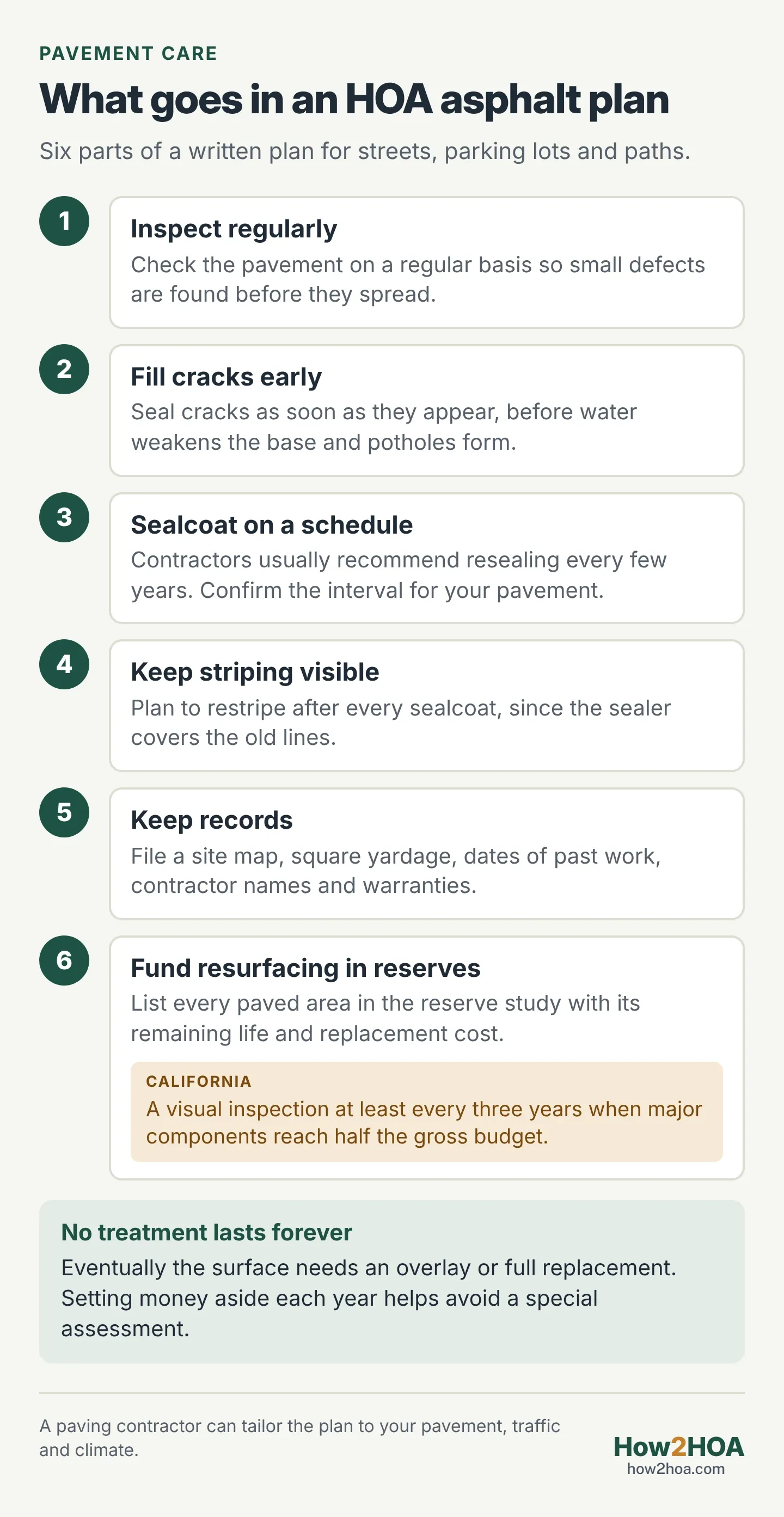
Sealcoat on a Schedule
A sealcoat is a thin protective layer applied over sound asphalt. It shields the surface from sun, water, chemicals and everyday wear, and it gives older pavement a fresh, uniform black finish. Contractors usually recommend resealing every few years. The right interval depends on traffic, climate, the product used and the condition of the pavement, so treat any number as a range to confirm with your paving contractor and your reserve study instead of a fixed rule.
Consider Rejuvenation
Rejuvenation is another surface treatment. A rejuvenator is sprayed on and is meant to soak into the top of the pavement and restore some flexibility to asphalt binder that has aged and stiffened. More flexible pavement handles temperature swings better, which helps slow cracking. Like other spray-applied treatments, a rejuvenator can leave the surface slick until it cures, so ask your contractor how long traffic should be kept off or slowed down afterward.
How long the benefit lasts varies with the product and the pavement, and claims that a treatment will extend pavement life indefinitely should be treated with caution. Because a rejuvenator has to penetrate the surface, ask your contractor whether earlier sealcoats on the same pavement affect how well it will work.
Fill Cracks Early
Have your contractor fill and seal cracks as soon as they appear. Water that gets through a crack weakens the base under the pavement, and that is how small cracks turn into potholes and failed sections. Crack sealing is a relatively inexpensive treatment and works best on pavement that is still in good condition. A Federal Highway Administration guide to pavement preservation says crack and fog seals can extend the life of pavement in good condition by one to four years. Those figures come from public roads, so expect your own results to differ with climate, traffic and the condition of the pavement.
Maintain Striping and Markings
If your pavement has markings for parking stalls, accessible spaces, fire lanes, crosswalks or speed humps, maintain them too. Faded markings cause parking disputes and safety problems, and fresh striping does a lot for curb appeal. Plan to restripe after every sealcoat, since the sealer covers the old lines, and ask your contractor to confirm that the layout of accessible spaces and fire lanes meets current local requirements.
Keep Records
The board should keep organized records of every inspection, treatment and repair. When new directors are elected, the file lets them continue the plan without starting over. Useful records include a site map of all paved areas, the total square yardage, dates and details of past maintenance, contractor names and warranties, and sign and striping layouts. Keep them with the rest of the association’s records.
Plan for Resurfacing in the Reserve Study
No treatment makes asphalt last forever. Eventually the surface needs an overlay (a new layer of asphalt over the old) or full removal and replacement, and that is one of the larger expenses many associations face. The reserve study should list every paved area, estimate its remaining useful life and replacement cost, and set aside money each year so the work does not require a special assessment. A reserve specialist can coordinate with your paving contractor so the maintenance schedule and the funding plan match.
Pavement life varies widely with the original construction, drainage, climate, traffic (especially garbage and delivery trucks) and how well it has been maintained. The same Federal Highway Administration guide puts the added life from a thin overlay at roughly five to twelve years on public roads. Use figures like these as a starting point and let your contractor and reserve specialist set the numbers for your property.
Hiring a Paving Contractor
Hiring a paving contractor is much like hiring any other contractor. Make sure each bidder has the right license, insurance coverage and permits. Collect at least three written bids on the same scope of work, ask for references and look at comparable jobs each bidder has finished.
Price will be a priority when the bids come in. If one bid is much higher or lower than the others, find out why. Methods and materials differ, so a low bid sometimes reflects a more efficient approach, and sometimes it reflects thinner asphalt, less surface preparation or fewer coats of sealer. Where bids differ in the process they propose, ask each bidder to explain its approach in writing. Those answers can move a company to the top of the list or take it off entirely. You will never know as much as the experts, so ask as many questions as you need to.
Paving and sealing close areas that most residents use every day. A good contractor will ask how to cause the least disruption and will want to know about trash pickup days, residents with disabilities or limited mobility who need access, deliveries, school schedules and events at the clubhouse. Plan the work in phases so people can still reach their homes, and give residents written notice of the dates, where to park and how long to stay off the new surface.
In California
- Reserve study. Civil Code section 5550 requires the board, at least once every three years, to have a visual inspection made of the accessible areas of the major components the association must repair, replace, restore or maintain, when the replacement value of those components is at least half of the association’s gross budget, not counting the reserve account. The study has to identify components with a remaining useful life of less than 30 years, and the board must review it annually. Private streets and parking lots that the association maintains normally belong in it.
- Who maintains what. Under Civil Code section 4775, unless the declaration says otherwise, the association repairs, replaces and maintains the common area. Check your CC&Rs for driveways and assigned parking, which may be treated differently.
- Contractor license. The Contractors State License Board licenses paving under the C-12 Earthwork and Paving classification, and protective coatings, striping and markings on parking areas and roads under C-32 Parking and Highway Improvement. Confirm that the license is active and that its classification covers your job with CSLB’s Check a License search.
Concrete sidewalks, curbs and pool decks need a different approach, which we cover in HOA concrete repair and maintenance. For more on upkeep and contractors, visit our maintenance and vendors section.
To put this into practice, use the free HOA Asphalt Paving Bid Checklist and Pavement Plan.
The Law Behind This Article
Every legal point in this article comes from the official text. Each link below opens it in a new tab.
Civil Code sections: 4775 · 5550
Other sources: FHWA: Pavement Preservation Guide · CSLB: C-12 Earthwork and Paving Classification · CSLB: C-32 Parking and Highway Improvement Classification
This article is general educational information, not legal or financial advice. Laws vary by state and your association’s governing documents control many of these questions, so check with your association’s attorney or another qualified professional about your situation.