
HOA concrete maintenance comes down to three habits: inspect sidewalks, patios, pool decks and other concrete regularly, repair small cracks and uneven spots before they grow, and know from your governing documents who is responsible for each surface. Concrete that is kept up can last a very long time, though how long depends on climate, soil, drainage and use. Concrete that is ignored becomes a trip hazard and an expensive replacement.
Owners expect clean, safe common areas. Nobody comments on a sidewalk in good condition, but residents notice cracks, raised edges and standing water quickly. Damage hurts the look of the community, and it creates a safety problem that can turn into an injury claim against the association. Repairs that are put off also tend to arrive all at once and strain the operating budget.
Why HOA Concrete Maintenance Matters
Concrete is strong, but it is porous, which is why it needs attention. (Cement is the ingredient that binds concrete together. The two words are often used as if they meant the same thing.) Water soaks into the surface and into any crack. In cold climates that water freezes and expands, and in any climate it can wash out or soften the soil underneath, so a slab settles or tilts. Tree roots lift panels, de-icing salts and pool chemicals wear the surface, and heavy vehicles crack slabs that were not built for them.

Share this infographic: Pinterest · Facebook · LinkedIn · Email · Download
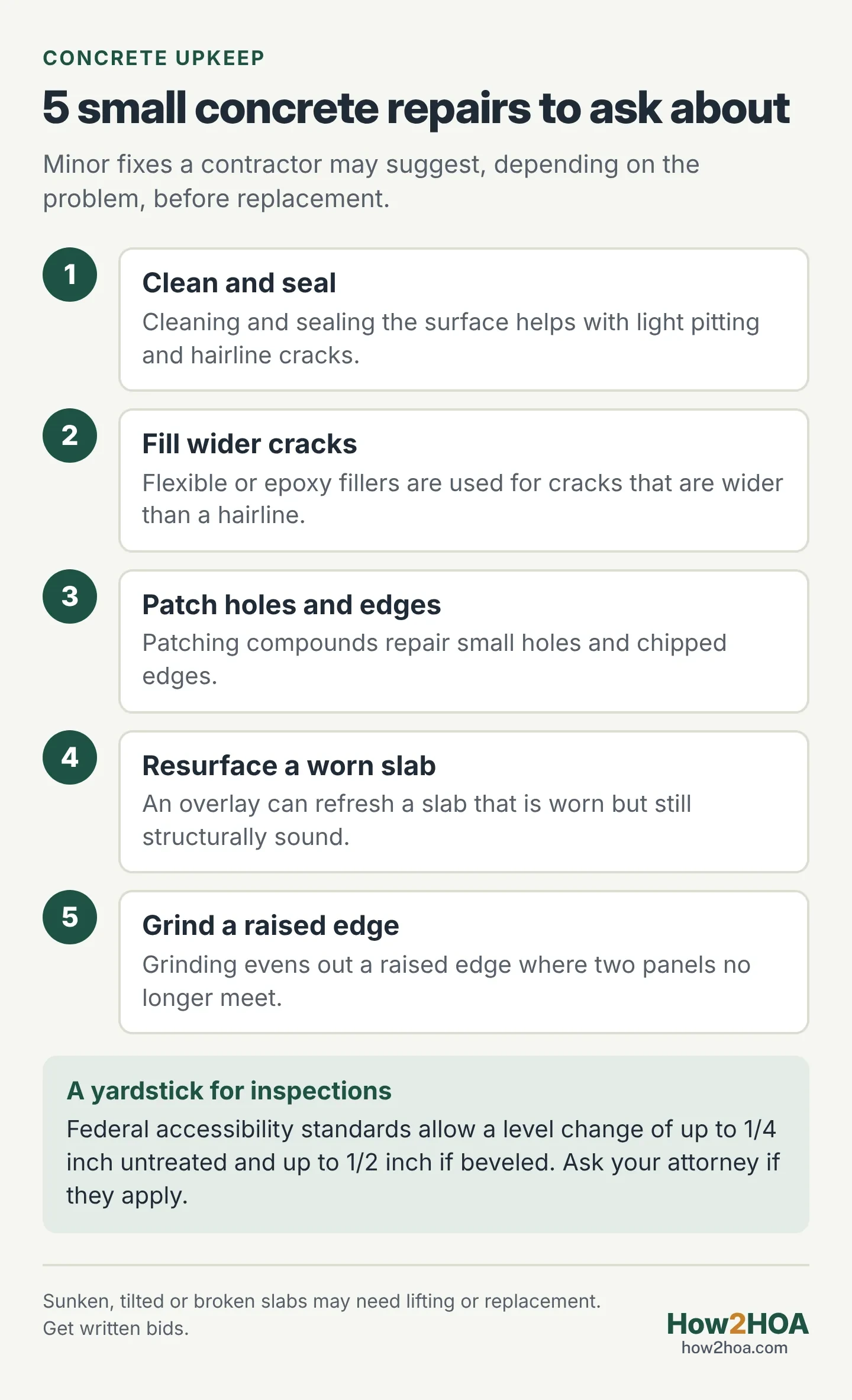
Small problems grow. A hairline crack lets in more water, the crack widens and the edges begin to crumble or shift. Uneven or crumbling concrete is a safety hazard and costs far more to correct than an early repair, and residents are inconvenienced both by the damage and by the closures while larger repairs are made. The best approach is to walk the property on a regular schedule and deal with small defects promptly. Many associations inspect once or twice a year and again after severe weather. The right frequency for your community depends on its climate and on how heavily the surfaces are used.
Minor repairs can be simple. Depending on the problem, a contractor may suggest:
- Cleaning and sealing the surface, which helps with light pitting and hairline cracks
- Flexible or epoxy fillers for wider cracks
- Patching compounds for small holes and chipped edges
- A resurfacing overlay to refresh a slab that is worn but structurally sound
- Grinding down a raised edge where two panels no longer meet evenly
A patio or pool deck that is sound apart from surface wear can sometimes be covered with a coating or interlocking deck tiles instead of being demolished. Ask a contractor to confirm the slab underneath is stable first.
When to Bring in a Pro for HOA Concrete Repair
Even small cracks are worth fixing right away, and patching them is inexpensive compared with what follows if they are left alone. When a slab has sunk, tilted, broken into pieces or started holding water, it may need to be lifted, partly replaced or fully replaced, and the cost rises quickly with the area involved. Get written bids so the board knows the real numbers before it decides.
Some small jobs can be handled by maintenance staff or a handyman with experience, using a self-leveling crack sealer or a patch kit. For work in common areas, though, the association is responsible for the result, so it rarely hurts to have even minor repairs done by a professional. Call a concrete contractor when the job involves:
- Replacing uneven, sunken or broken concrete
- Lifting and leveling settled slabs
- Grinding and polishing
- Deep cleaning or pressure washing that could damage the surface if done wrong
- Sealing with epoxy or other coatings
- Anything near a pool, a structural element, stairs or a ramp
Changes in level are the defect most likely to cause a fall. As a point of reference, the federal accessibility standards allow a vertical change of up to a quarter inch without treatment and up to a half inch if the edge is beveled, according to the U.S. Access Board. Whether those standards legally apply to a given part of your property is a question for your attorney, but the measurements are a useful yardstick during inspections. Document each inspection and repair, because a record of regular attention is part of how a board limits the association’s liability.
When you hire, follow the same steps as for any vendor: a written scope, at least three bids, and license and insurance checks. Our article on how to hire a contractor walks through them.
Concrete and Condos: Who Is Responsible for the Repair
Condominium associations may have less open common area than a community of single-family homes, but concrete raises harder questions for them, because the building itself is often concrete: foundations, floor slabs, parking garages, stairs, walkways and balconies.
When concrete is damaged in or next to a unit, the first question is who is responsible for the repair, the association or the owner. The answer depends on how the governing documents classify the damaged element. Most declarations (CC&Rs) and condominium plans divide the property into three categories:
- Common area. Everything owned in common, which in a condominium usually includes the structure of the building. The association normally maintains, repairs and replaces it.
- Exclusive use common area. Common area set aside for one owner’s use, such as a balcony, patio or assigned parking space. Documents often split the duties here, for example by having the owner handle routine upkeep and the association handle repair and replacement.
- Separate interest. The unit itself, which the owner maintains. In many condominiums the unit is defined as the airspace and interior surfaces, so the concrete slab under an owner’s flooring is common area even though the flooring belongs to the owner.
Every association’s documents draw these lines a little differently, so read the definitions and the maintenance section of your own governing documents before deciding who pays.
Cause matters too. Damage inside a unit may come from a crack in concrete the association maintains. The crack may in turn have been caused by a water leak, and the leak may have started in the owner’s plumbing or in the association’s. Responsibility for making the repair and responsibility for paying for it can end up with different parties, and insurance may cover part of the loss. When the facts are unclear, bring in a qualified inspector or engineer to identify the cause, notify the insurers and ask the association’s attorney how the documents apply.
Decorative Concrete Finishes
Maintenance keeps concrete safe and sound. If the association has the budget and the interest, you can also improve how it looks. When a walkway, entry or pool deck is due for replacement or resurfacing anyway, ask your contractor about stamped patterns, textured finishes, exposed aggregate or integral color. Ask how each finish holds up, how slippery it is when wet and what it takes to maintain before choosing on looks alone.
Plan Concrete Work in the Budget and Reserves
Small repairs such as crack filling, patching and grinding belong in the annual operating budget. Replacing sidewalks, curbs, pool decks or garage slabs is a long-term expense that should appear in the reserve study with an estimated remaining life and cost, so the money is there when the work is needed. A reserve specialist can help the board set those numbers for your property, since useful life and replacement cost vary with climate, soil, use and local prices.
In California
The Davis-Stirling Act supplies default rules that apply unless the declaration says otherwise.
- Who repairs what. Under Civil Code section 4775, the association is responsible for repairing, replacing and maintaining the common area. Each owner is responsible for repairing, replacing and maintaining the separate interest. For exclusive use common area, the owner is responsible for maintaining it and the association is responsible for repairing and replacing it.
- Exclusive use common area. Civil Code section 4145 lists doorsteps, stoops, porches, balconies and patios designed to serve a single separate interest among the items that are exclusive use common area allocated to that unit, unless the declaration provides otherwise.
- Unit boundaries. Under Civil Code section 4185, unless the declaration or condominium plan provides otherwise, when walls, floors or ceilings are the boundaries of a unit, the interior surfaces are part of the separate interest and the other portions of the walls, floors and ceilings are common area.
- Temporary relocation. Section 4775 also says the owner of the affected unit bears the cost of temporary relocation while the association repairs or maintains areas it is responsible for.
- Contractor license. The Contractors State License Board licenses concrete work under the C-8 Concrete Contractor classification. C-8 is one of the classifications that must carry workers’ compensation insurance whether or not the contractor has employees. Verify the license with CSLB’s Check a License search.
For more articles on upkeep and contractors, visit our maintenance and vendors section. Asphalt streets and parking lots are covered in pavement and asphalt management.
Our free HOA Concrete and Trip Hazard Bid Checklist can help your board put this into practice.
The Law Behind This Article
Every legal point in this article comes from the official text. Each link below opens it in a new tab.
Civil Code sections: 4145 · 4185 · 4775
Other sources: U.S. Access Board: Guide to Floor and Ground Surfaces · CSLB: C-8 Concrete Contractor Classification · CSLB: Workers’ Compensation Requirements
This article is general educational information, not legal or financial advice. Laws vary by state and your association’s governing documents control many of these questions, so check with your association’s attorney or another qualified professional about your situation.