
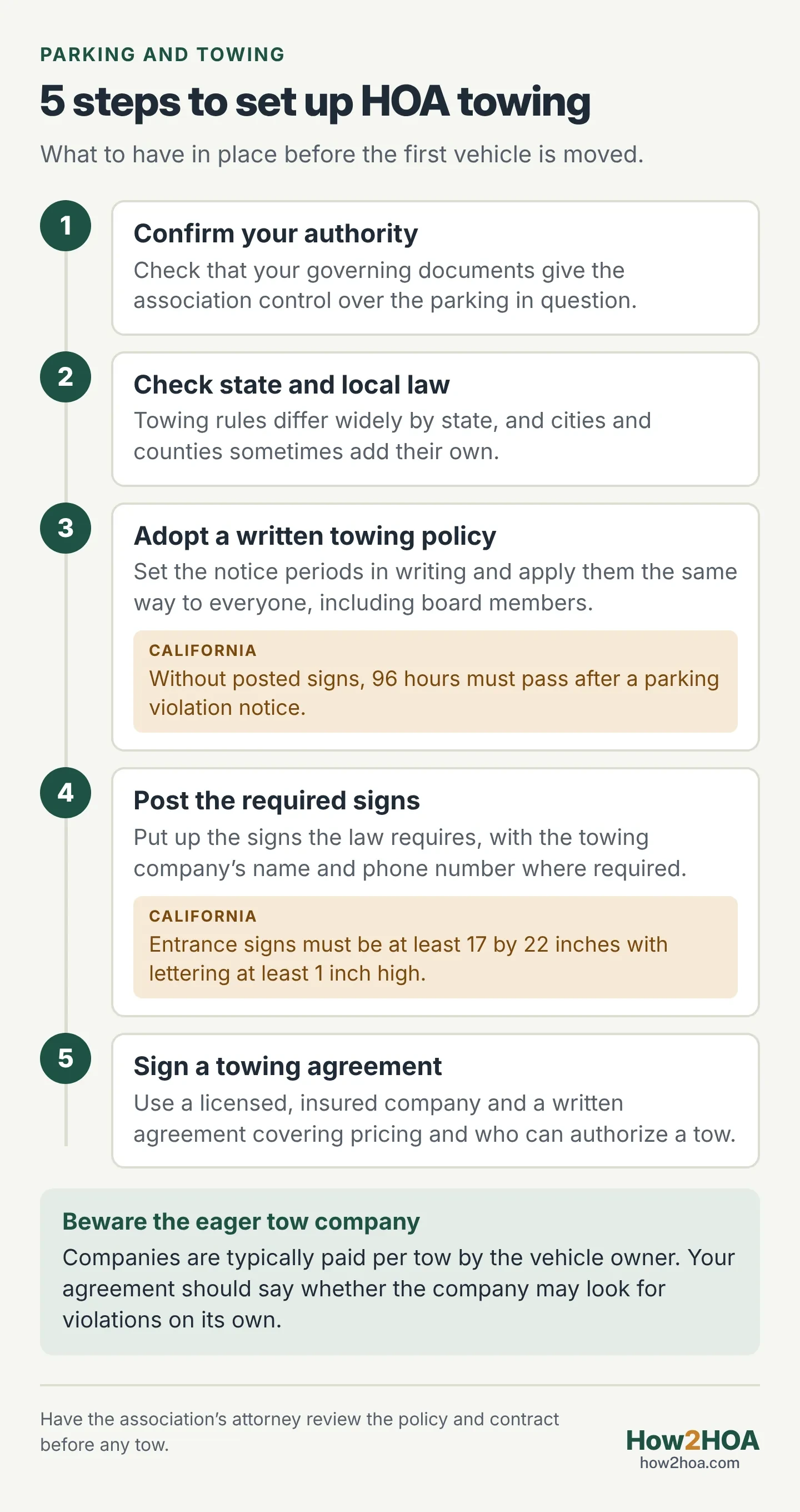
To set up HOA towing, confirm that your governing documents give the association authority over parking, check what state and local law require, adopt a written towing policy, post the required signs, and sign a written agreement with a licensed, insured towing company. Towing takes someone’s property, and the rules are detailed, so have the association’s attorney review the policy and the contract before the first vehicle is moved.
Nearly every association has parking rules, and nearly every association sees them broken at times. Most parking problems can be solved with a reminder or the association’s normal enforcement process of notice, hearing and fines. Sometimes towing is the only practical option. This article covers what to look out for and how to keep the process fair and lawful.
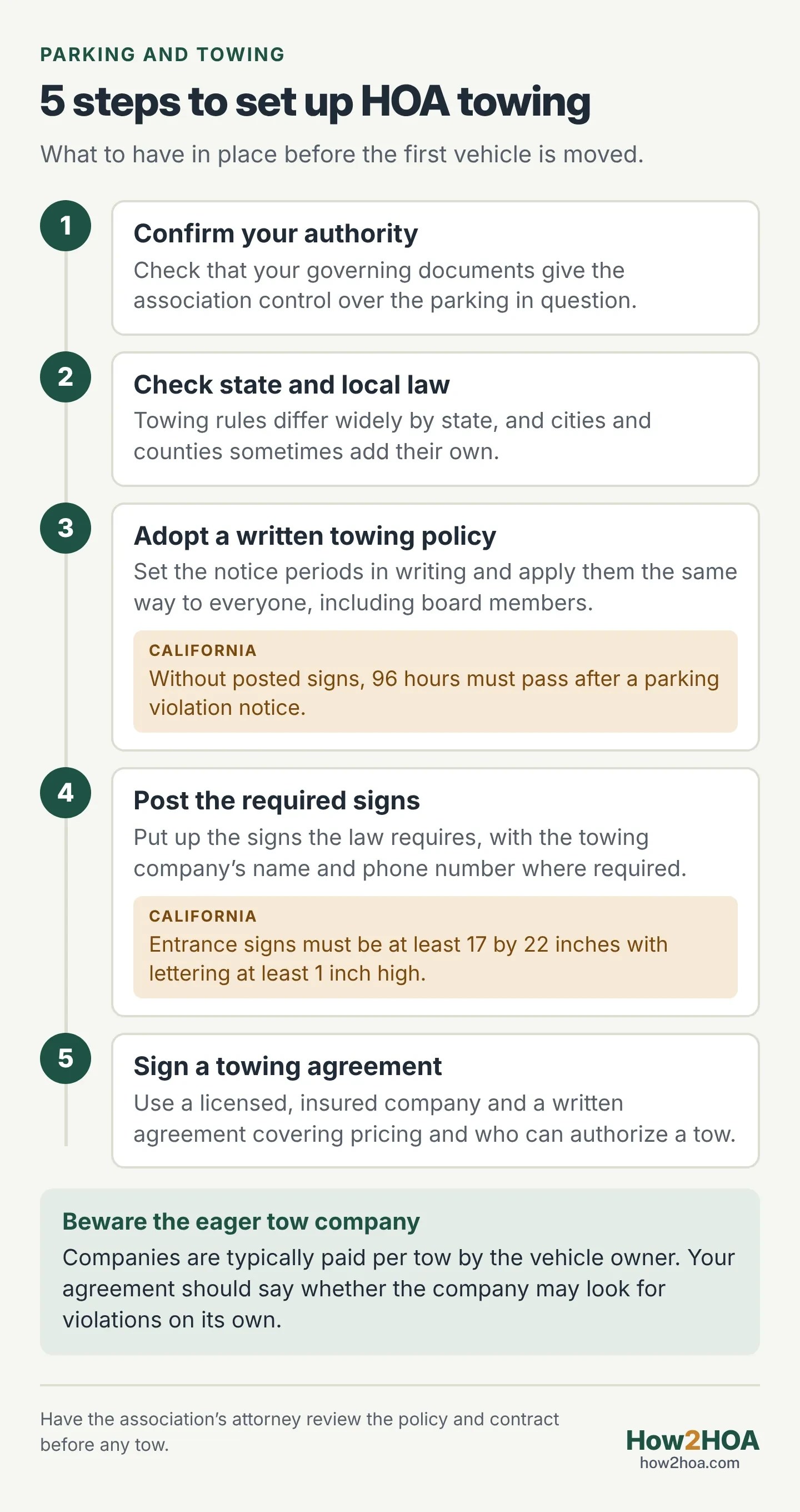
Share this infographic: Pinterest · Facebook · LinkedIn · Email · Download
Check State and Local Laws First
Many states regulate what an association must do before towing a vehicle from private property and what it may not do, and those laws differ widely. Some states set only broad requirements, such as clear signs stating when parking is allowed and what the towing fees are. Others are specific. California, for example, spells out the size and wording of the signs at each entrance, the waiting period after a parking notice is placed on a vehicle, and the paperwork needed for each tow. Cities and counties sometimes add their own rules, so check with the local police or code enforcement office as well.
The penalties for a wrongful tow can be significant. In California, for example, an association that skips the required steps is liable to the vehicle’s owner for double the towing or storage charges, as described in the California section below.
The rules can also differ for deeded spaces, assigned spaces, guest parking and permit or sticker systems, and an association’s authority over public streets inside the community is usually much more limited than its authority over private streets and common area parking. Start with your governing documents to confirm what the association controls. A reputable towing company will know the state law, which helps, but the association is still responsible for following it.
Hiring a Towing Company
Before you sign with a towing company, make sure you need one. If there have been only one or two problems, a contract is probably not worth it. If violations are frequent, or if blocked fire lanes and driveways are a recurring safety issue, a standing arrangement makes sense.
As with any vendor, confirm that the towing company holds the licenses or permits your state and city require and carries insurance, including coverage for vehicles in its care. The association is authorizing the removal of someone’s property, so the company you choose reflects on the board.
The association should also have a written agreement with any towing company it uses. The agreement should cover:
- Pricing. What the company charges vehicle owners for towing and storage, and which fees the association will not pay. Some companies bill the association after the fact, for example when a vehicle is never claimed.
- Who can authorize a tow. The names or positions of the people allowed to request one, and the form the request must take.
- Indemnification. If the towing company breaks the law, the association can be drawn into the claim or penalized. An indemnification clause obligates the company to reimburse the association for fines, damages and legal costs that result from the company’s own unlawful or negligent actions. Ask the attorney to make sure the clause is backed by the company’s insurance.
- Notice and patrols. The minimum notice given to violators and whether the company may look for violations on its own.
- Compliance. The company’s commitment to follow state and local towing law, including sign, notice, storage and release requirements.
Be wary of an overeager towing company. Because towing companies are typically paid by the vehicle owner for each tow, a company allowed to patrol on its own has an incentive to tow for the smallest violation, including ones nobody reported, and homeowners will blame the board. Your agreement should say how proactive the company may be. In California, as described below, the law itself bars handing that general authority to the tow company except for fire hydrants, fire lanes and blocked entrances or exits.
When you hire a company, remind all residents of the parking rules and explain when and how towing will happen. The towing company’s name and telephone number should appear on the parking signs where the law requires it.
HOA Towing Notice: How Much Warning to Give
Where the law does not set a notice period, the board decides how much warning to give before a tow. Many associations place a written warning on the vehicle and allow a set period to move it, with exceptions for vehicles that create an immediate hazard, such as blocking a fire lane, a hydrant or another resident’s driveway. State or local law may set the minimum, as California’s 96-hour rule does for properties that rely on a parking notice instead of posted signs.
Put the notice periods in the written towing policy and apply them the same way to everyone, including board members. Consistent enforcement is fairer, and it is also the association’s best defense when an owner disputes a tow.
What a Towing Request Should Include
Owners sometimes dispute whether a vehicle should have been towed, so a written request for each tow protects the board. California’s Vehicle Code section 22658 requires the written authorization to contain the items below, and they make a sound checklist anywhere:
- The make, model, vehicle identification number and license plate number of the vehicle
- The name, signature, job title, residential or business address and working telephone number of the person authorizing the tow
- The grounds for removing the vehicle
- The time the vehicle was first observed parked on the property
- The time the tow was authorized
Take dated photos of the vehicle, the violation and the nearest sign, and keep the request and photos with the association’s records.
Inoperable or “Junk” Vehicles
Parking violations are the most common reason associations tow, but towing may also come up for abandoned or deteriorating vehicles that the rules treat as unsightly or hazardous. Dealing with them protects the rest of the community and upholds the standards residents expect.
Before you act, check the CC&Rs and the association’s rules. Some require every vehicle kept in the community to be operable and currently registered, which a truly nonfunctioning vehicle cannot satisfy. If a car is missing doors or tires or is rusted through, you will not want to wait for its registration to expire. Make sure your rules address inoperable vehicles directly so you have clear authority, and follow any state procedure. In California, that means notifying local traffic law enforcement and waiting 24 hours, as described below.
Other Reasons to Tow
Your association probably has rules about parking trailers, boats, recreational vehicles and other large vehicles in the community. If those rules are violated and warnings do not work, towing may be an option. Many associations build in reasonable exceptions, such as allowing an RV to sit in a driveway for a day or two so a family can load or unload for a trip.
Towing should be the last step, after the association’s ordinary process for rules and violations has not solved the problem.
In California: Vehicle Code 22658
California Vehicle Code section 22658 governs towing from private property and names the association of a common interest development as a party that may have a vehicle removed. As of this writing, its main requirements for associations are these.
When a Vehicle May Be Towed
The association may have a vehicle removed only if one of these conditions is met:
- Signs are posted. A sign at least 17 by 22 inches, with lettering at least one inch high, is displayed in plain view at all entrances to the property. It must prohibit public parking, state that vehicles will be removed at the owner’s expense, and give the telephone number of the local traffic law enforcement agency and the name and telephone number of each towing company that has a written general towing authorization agreement with the association.
- A parking notice was issued. The vehicle has been issued a notice of parking violation and 96 hours have passed since the notice.
- The vehicle is inoperable. The vehicle lacks an engine, transmission, wheels, tires, doors, windshield or another major part needed to operate safely on the highway, the association has notified the local traffic law enforcement agency, and 24 hours have passed since that notification.
- The lot has a single-family home on it. The vehicle is parked on a lot improved with a single-family dwelling.
What the Association Must Do for Each Tow
- Authorize each tow in writing. The towing company may not remove a vehicle without written authorization from the association or its employee or agent, and that person must be present at the time of removal and verify the violation.
- Do not hand the decision to the tow company. A general authorization to tow without a specific request cannot be delegated to a towing company or its affiliates, with one exception: under a written agreement, the company may remove vehicles parked within 15 feet of a fire hydrant, in a fire lane, or blocking an entrance or exit, and it must photograph the violation first.
- Notify law enforcement. The association must notify the local traffic law enforcement agency by telephone, or by the fastest means available if a call is impractical, within one hour after authorizing the tow.
- Give the reason if asked. If the vehicle’s owner asks, the association must state the grounds for the removal.
Limits and Penalties
- An association that tows without meeting the sign, 96-hour or 24-hour conditions, or that fails to state the grounds for removal when asked, is liable to the vehicle’s owner for double the towing or storage charges.
- A towing company that removes a vehicle without the required written authorization commits a misdemeanor and is liable to the vehicle’s owner for four times the towing and storage charges.
- If the vehicle’s owner returns before the vehicle has left the property and asks for it, the towing company must release it immediately and unconditionally. If the vehicle was already hooked up to the tow truck, the company may charge no more than half its regular towing fee.
- The statute limits towing and storage charges, generally requires the storage yard to be within 10 miles of the property, and requires the tow operator to give written notice to the vehicle’s registered and legal owner when they can be identified.
When the board adopts or changes a parking or towing rule, it should also follow the rule-change procedure in Civil Code section 4360. That section requires general notice to the members of a proposed rule change, with its text and an explanation of its purpose and effect, at least 28 days before the board acts, and requires the board to consider member comments before deciding at a board meeting. Ask the attorney to confirm how it applies to your policy. Our overview of the Davis-Stirling Act explains how these rules fit together.
Section 22658 is long, and this summary leaves out details. Have the association’s attorney check the policy, the signs and the towing agreement against the current statute.
For related topics, see our maintenance and vendors section.
The Law Behind This Article
Every legal point in this article comes from the official text. Each link below opens it in a new tab.
Civil Code sections: 4360
Vehicle Code sections: 22658
This article is general educational information, not legal advice. Laws vary by state and your association’s governing documents control many of these questions, so check with your association’s attorney or another qualified professional about your situation.