There is no single answer to who pays for a condo water leak, because a leak raises three separate questions: who has to fix the thing that leaked, who has to repair the damage it caused, and whose insurance pays. The answers often point to different people. As a general rule, whoever is responsible for maintaining the failed component fixes it, each party repairs the property it is responsible for, and a party pays for someone else’s damage only if it was negligent or the CC&Rs (covenants, conditions and restrictions) say so.
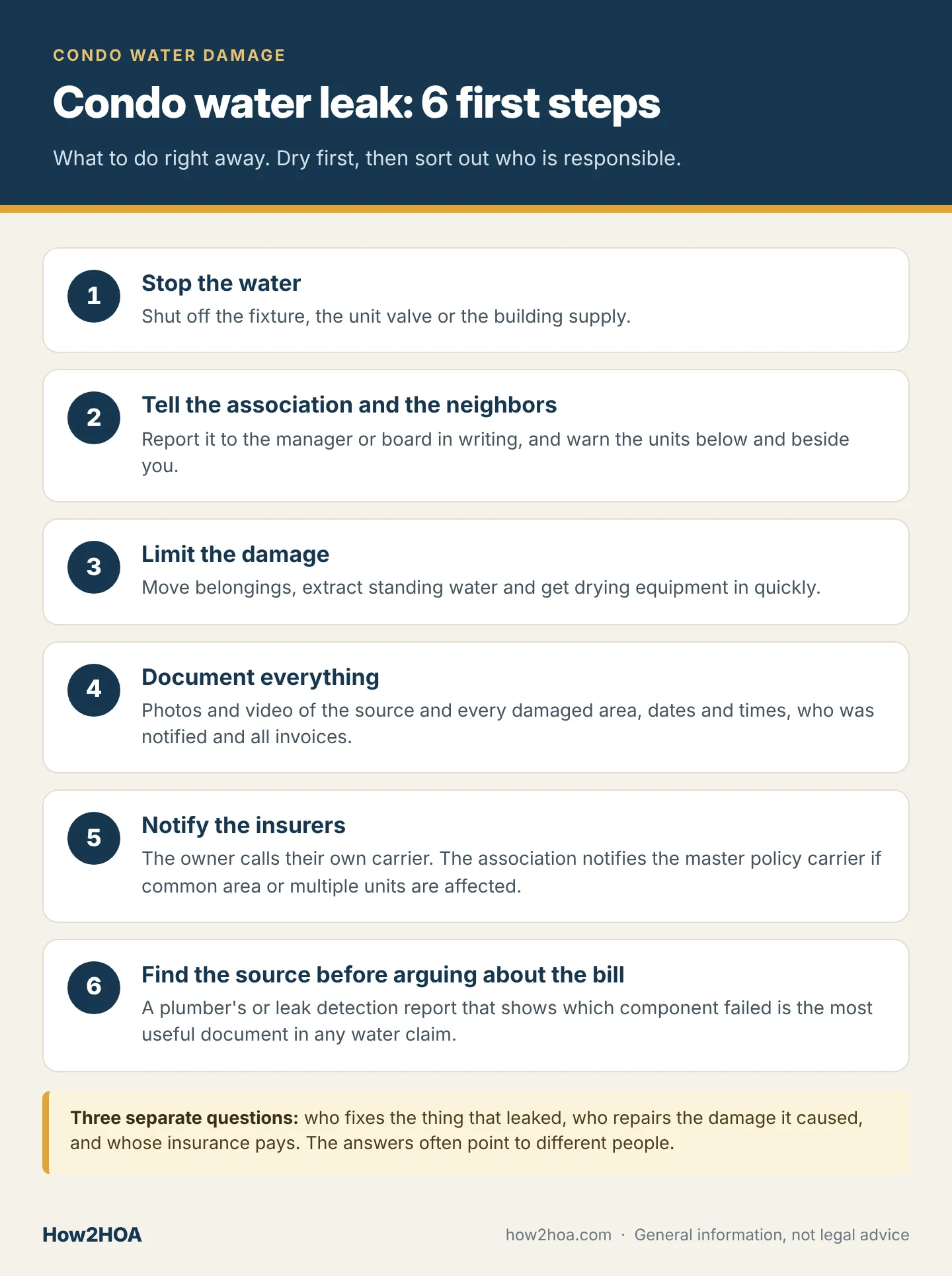
First steps when a leak happens
- Stop the water. Shut off the fixture, the unit valve or the building supply. Every resident should know where the unit shutoff is.
- Tell the association and the neighbors right away. Report it to the manager or board in writing, and warn the units below and beside you.
- Limit the damage. Move belongings, extract standing water and get drying equipment in quickly. Insurance policies generally require the policyholder to take reasonable steps to prevent further damage.
- Document everything. Photos and video of the source and every damaged area, dates and times, who was notified and when, and all invoices.
- Notify the insurers. The owner calls their own carrier, and the association notifies the master policy carrier if common area or multiple units are affected.
- Find the source before arguing about the bill. A plumber’s or leak detection report that identifies exactly which component failed is the most useful document in any water claim.

Share this infographic: Pinterest · Facebook · LinkedIn · Email · Download
Question 1: Who repairs the source?
The source is the pipe, fitting, appliance, roof, window or drain that failed. Responsibility for it follows the maintenance rules in the CC&Rs, which usually divide the building into three categories:
- Common area. Roofs, exterior walls, foundations and shared pipes such as main supply lines and drain stacks. Normally the association’s job.
- The unit (separate interest). Fixtures and appliances inside the unit such as toilets, sinks, water heaters, dishwashers, washing machine hoses and supply lines. Normally the owner’s job.
- Exclusive use common area. Parts of the common area that serve only one unit, such as a balcony, a window or sometimes a pipe that serves a single unit. Documents split these in different ways. See our guide to exclusive use common area.
Pipes inside walls cause the most disputes. Many CC&Rs draw the line at whether a pipe serves one unit or more than one. Others draw it at the unit boundary. Read the definitions of “unit” and “common area” and the maintenance section together. For the general framework, see who pays for repairs in an HOA.
Question 2: Who repairs the resulting damage?
This is where expectations and reality part ways. The owner whose ceiling collapsed assumes the upstairs neighbor or the association must pay. Often that is not the case.
- Each party usually repairs its own property. The association repairs damaged common area (framing, insulation, and in some documents the drywall). Each owner repairs their own unit interior: flooring, cabinets, paint and personal belongings.
- Fault can shift the cost. If the leak came from negligence, the negligent party can be liable for the damage to others. Examples: an owner who ignored a dripping supply line or left a tub running, or an association that knew a roof or pipe was failing and did nothing.
- No fault often means no reimbursement. A pipe that fails suddenly with no warning may not be anyone’s negligence. In that case each party typically bears its own repair costs and turns to its own insurance.
- The CC&Rs can change the outcome. Some documents make an owner responsible for all damage that originates in their unit regardless of fault, or let the association charge an owner for damage the owner or their tenant caused. Check yours.
Question 3: Whose insurance pays?
Two kinds of policy are usually involved.
- The association’s master policy. It covers the buildings and common area. How far it reaches into the units depends on the policy and the CC&Rs. A “bare walls” policy stops at the unfinished surfaces. Other policies cover original fixtures and finishes, and some cover owner upgrades. See what HOA insurance covers.
- The owner’s HO-6 policy. A condo unit owner’s policy covers the interior elements the master policy does not, the owner’s belongings, personal liability if the owner is at fault for damage to others, and additional living expenses if the unit cannot be occupied. Our article on homeowners insurance in an HOA explains what to buy.
Three practical points:
- Deductibles. Master policy water deductibles can be large, and many leaks cost less than the deductible, so the master policy pays nothing. Governing documents and state law determine whether the association can charge the deductible to the owner whose unit was the source. Owners can ask their agent about loss assessment coverage for that situation. See HOA insurance deductibles and loss assessments.
- Gradual leaks. Property policies generally cover sudden and accidental discharge. Long-term seepage, wear and deferred maintenance are commonly excluded.
- Claims history. Boards often choose not to file small water claims because frequent claims can affect premiums and renewal. That is a business decision the board should make with its agent.
Mold
The U.S. Environmental Protection Agency advises drying water-damaged areas and items within 24 to 48 hours to prevent mold growth, which is why fast drying matters more than who is at fault. Many property policies limit or exclude mold coverage, so a slow response can turn an insured water loss into an uninsured mold problem. Dry first, then sort out responsibility. If mold is suspected in wall cavities, get a qualified inspection before closing the walls.
Why boards should adopt a written water intrusion policy
Most water disputes come from uncertainty, not bad faith. A written policy, reviewed by the association’s attorney and consistent with the CC&Rs, should cover:
- Reporting. Who to call, including after hours, and the duty to report leaks promptly.
- Access. How the association enters a unit in an emergency to stop a leak.
- Initial response. Who orders leak detection and emergency dry-out, and how that cost is allocated once the source is known.
- A responsibility chart. Component by component: who maintains it, who repairs it and who insures it.
- Insurance and deductibles. When the association files a master policy claim and how the deductible is allocated.
- Owner requirements. Whether owners must carry HO-6 coverage, and prevention steps such as replacing supply lines and water heaters on a schedule.
Give the policy to every owner and tenant. A policy cannot override the CC&Rs. If the documents are unclear, an amendment may be needed. Good records of inspections and repairs also help show the association acted reasonably.
In California
The Davis-Stirling Act supplies default maintenance rules. The CC&Rs can change most of them, so always read both.
- Default maintenance allocation. Under Civil Code section 4775, unless the declaration provides otherwise, the association is responsible for repairing, replacing and maintaining the common area. Each owner is responsible for repairing, replacing and maintaining their separate interest. For exclusive use common area, the owner maintains it and the association repairs and replaces it.
- What counts as exclusive use common area. Civil Code section 4145 defines it as a portion of the common area designated by the declaration for the exclusive use of one or more, but fewer than all, owners. Unless the declaration says otherwise, it includes items designed to serve a single unit but located outside its boundaries, such as windows, exterior doors, balconies and patios. Whether a pipe serving one unit falls in this category depends on the declaration’s wording.
- Utility interruptions. Section 4775 also makes the association responsible, unless the declaration provides otherwise, for repairs needed to restore interrupted gas, heat, water or electrical service that begins in the common area, even if the problem extends into a unit. The board must begin the repair process within 14 days of the interruption. AB 1892, effective January 1, 2027, adjusts this wording, so check the current text.
- Temporary relocation. Under section 4775, the cost of temporary relocation during repair and maintenance of areas within the association’s responsibility is borne by the owner of the affected unit. This is one reason loss of use coverage in an HO-6 policy matters.
- Wood-destroying pests and organisms. In a condominium, Civil Code section 4780 makes the association responsible for repair and maintenance of the common area occasioned by wood-destroying pests or organisms, unless the declaration provides otherwise. This matters when a long-term leak leads to fungus or dry rot in the framing, which pest inspection reports commonly flag.
- Lawsuits over the common area. Under Civil Code section 5805, a tort claim based solely on an owner’s shared ownership of the common area must be brought against the association, not the individual owners, if the association carries general liability insurance of at least $2 million (100 or fewer separate interests) or $3 million (more than 100).
- Insurance disclosure. The annual budget report required by Civil Code section 5300 includes a summary of the association’s property and liability policies with limits and deductibles. Owners should give it to their own insurance agent each year.
Davis-Stirling does not make the association the insurer of everything inside a unit. California court decisions have generally tied an association’s liability for damage inside a unit to negligence or a breach of its duties under the governing documents, not to the mere fact that the water came from the common area. How that applies to a specific leak is a question for an attorney.
Our free Maintenance Responsibility Matrix helps the board chart who maintains, repairs and replaces each part of the property.
Frequently asked questions
My upstairs neighbor’s leak damaged my unit. Do they have to pay?
Only if they were negligent or your CC&Rs make them responsible. Either way, report the claim to your own HO-6 carrier. Your insurer can pay you and then pursue the responsible party if there is one.
Does the HOA have to fix my drywall and flooring?
It depends on where your documents draw the unit boundary and what the master policy covers. In many condominiums, interior finishes are the owner’s responsibility.
What if the source cannot be found?
Keep investigating. Without a documented source, no one can assign responsibility and insurers may deny claims. Splitting the cost of leak detection is usually cheaper than a dispute.
For more on maintenance responsibilities and vendors, visit the maintenance hub. Boards that want help with emergency response and claims handling can compare management options.
The Law Behind This Article
Every legal point in this article comes from the official text. Each link below opens it in a new tab.
Civil Code sections: 4145 · 4775 · 4780 · 5300 · 5805
Other sources: EPA: A Brief Guide to Mold, Moisture and Your Home
This article is general educational information, not legal or financial advice. Laws vary by state and your association’s governing documents control many of these questions, so check with your association’s attorney or another qualified professional about your situation.