When an HOA’s master insurance policy pays a claim, someone still has to cover the deductible, and who that is depends on the governing documents and any deductible policy the board has adopted. It may be the association as a whole, the owner whose unit was the source of the damage, or the owners whose units were damaged. Loss assessment coverage is the part of an individual owner’s policy that can help pay the owner’s share. Boards should explain all of this to owners every year, before a loss happens.
How master policy deductibles work
The association’s master property policy insures the buildings and other common property (see what homeowners association insurance covers for the scope). The deductible is the amount the association must absorb on each claim before the insurer pays. As premiums have climbed, many boards have accepted higher deductibles to keep coverage affordable, which makes the question of who pays more important than it used to be.
Deductibles come in several forms, and one policy can contain more than one.
- Flat per-occurrence deductible. A fixed dollar amount applied once to each loss event, regardless of how many units are affected.
- Per-unit deductible. A fixed dollar amount applied separately to each damaged unit. Insurers often use this for water damage. A single leak that damages four units means four deductibles.
- Percentage deductible. Common for wind, hail, wildfire and earthquake coverage. The percentage is usually applied to the insured value of the building or the policy limit, not to the amount of the loss, so the dollar figure can be very large.
Ask your broker for a one-page summary of every deductible in the program and a worked example of each. A percentage deductible in particular should be translated into dollars for each building so the board and owners understand the exposure.
Who pays the deductible after a loss
No single national rule answers this. The answer comes from three places, in this order: state law, the CC&Rs (covenants, conditions and restrictions), and any written policy the board has adopted under the authority the CC&Rs give it.
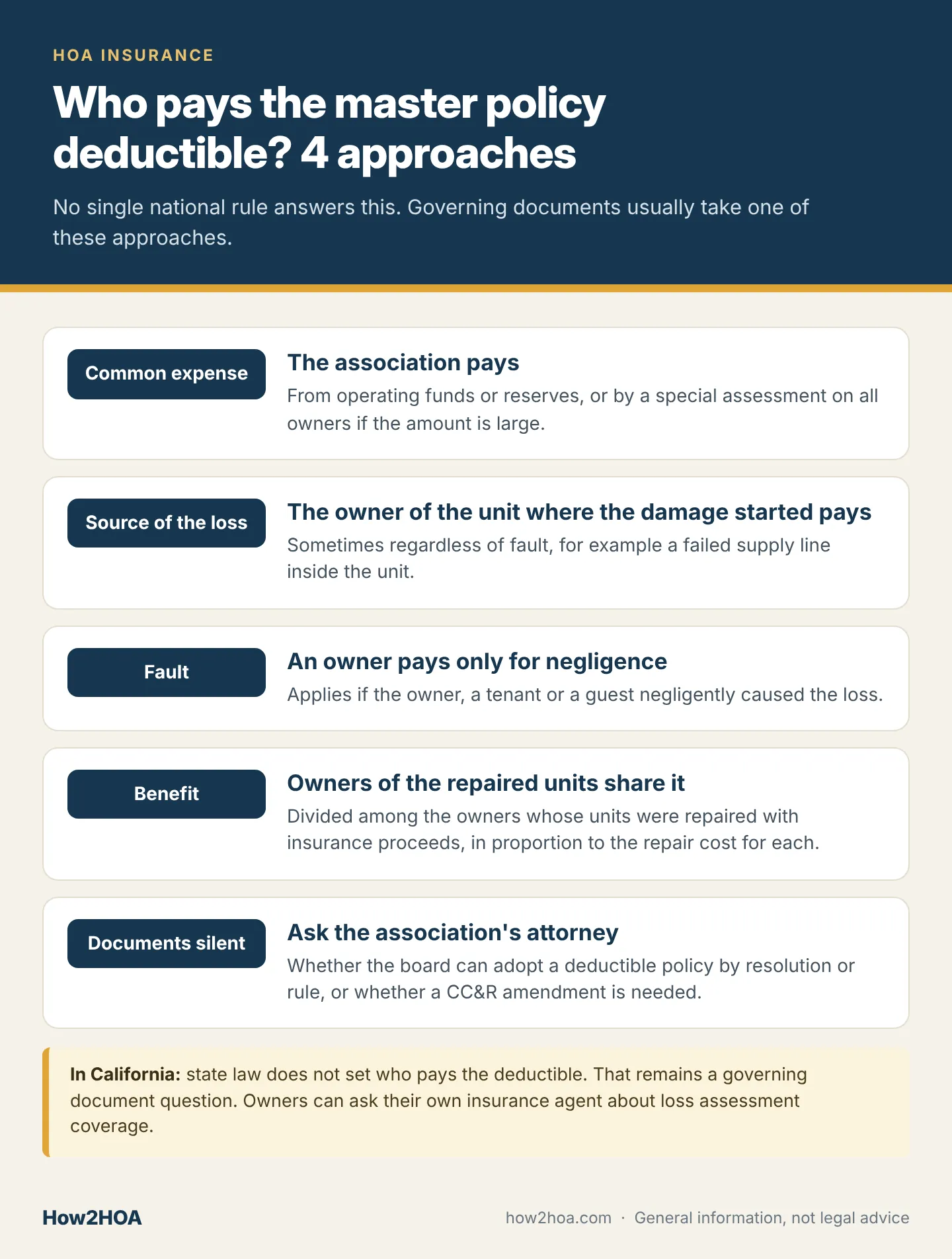
Governing documents usually take one of these approaches:
- Common expense. The association pays the deductible from operating funds or reserves, or by a special assessment on all owners if the amount is large.
- Source of the loss. The owner of the unit where the damage started pays, sometimes regardless of fault (for example, a failed supply line inside the unit).
- Fault. An owner pays only if the owner, a tenant or a guest negligently caused the loss.
- Benefit. The deductible is divided among the owners whose units were repaired with insurance proceeds, in proportion to the repair cost for each.
Many older CC&Rs say nothing useful. If yours are silent or unclear, the board should ask the association’s attorney whether it can adopt a deductible policy by resolution or rule, or whether a CC&R amendment is needed. A board policy cannot contradict the declaration. Our guide to who pays for repairs in an HOA covers the related question of repair responsibility.

Share this infographic: Pinterest · Facebook · LinkedIn · Email · Download
What a board deductible policy should cover
- Which approach above applies, with the CC&R section that authorizes it.
- When the association will file a claim and when it will not (for example, losses below or near the deductible).
- Who handles and pays for repairs that fall below the deductible.
- The notice and hearing steps before any amount is charged to an individual owner.
- A reminder that owners are expected to carry their own policy, with loss assessment coverage, if the documents require or recommend it.
What loss assessment coverage does
A condominium unit owner’s policy is commonly called an HO-6 (our homeowners insurance overview explains the basics). Loss assessment coverage is a feature of that policy. It pays the owner’s share of an assessment the association charges to owners because of a loss to property the owners hold in common, or a liability claim against the association, when the cause of the loss is one the owner’s own policy covers.
Typical situations where it may respond:
- The master policy deductible is assessed to owners after a covered loss.
- The loss exceeds the master policy limit and owners are assessed for the shortfall.
- A liability judgment or settlement against the association exceeds its liability limit.
Limits and sub-limits to watch
The details vary by insurer and policy form, so treat the following as questions to ask, not promises of coverage.
- The base limit is often low. Many policies include only a small amount of loss assessment coverage unless the owner buys a higher limit by endorsement. Higher limits are usually inexpensive relative to the rest of the premium.
- Deductible assessments may have their own cap. Some policies limit what they will pay toward an assessment that results from the association’s deductible to a small sub-limit, even when the owner has bought a much higher loss assessment limit. Owners should ask their agent directly whether that sub-limit applies and whether it can be raised or removed.
- The cause of loss must be covered. A standard unit owner policy typically excludes earthquake and flood, so it will not pay an assessment for the association’s earthquake deductible. Earthquake loss assessment coverage is purchased separately, for example through a condo unit earthquake policy.
- It is for shared assessments. Loss assessment coverage generally responds to assessments levied on owners as a group. When a deductible is charged to one owner because the loss started in that owner’s unit, a different part of the owner’s policy (dwelling or personal liability coverage) may be the one that applies. The owner’s agent or insurer can confirm.
- Not every assessment is a loss assessment. Assessments for deferred maintenance, underfunded reserves or planned projects are not covered.
In California: what the Davis-Stirling Act requires
California law does not set a statewide rule on who pays the master policy deductible. That remains a governing document question. What the Davis-Stirling Common Interest Development Act does require is disclosure, so owners can insure themselves properly.
Annual insurance summary (section 5300)
Under Civil Code section 5300, the association must distribute an annual budget report 30 to 90 days before the end of its fiscal year. Subdivision (b)(9) requires that report to include a summary of the association’s property, general liability, earthquake, flood and fidelity insurance policies. For each policy the summary must state:
- The name of the insurer.
- The type of insurance.
- The policy limit.
- The amount of the deductible, if any.
To the extent the policy declaration page contains that information, the association may meet the requirement by distributing a copy of the declaration page.
The summary must also carry a specific statement, printed in at least 10-point boldface type. The statute supplies the wording, so copy it exactly from the code section. In substance it tells members that the summary is not a substitute for the full policies, that they may review the policies on reasonable notice and obtain copies for a reasonable duplication charge, that the association’s policies may not cover their property, including personal property or real property improvements to or around their dwelling, or personal injuries or other losses that occur within or around their dwelling, that even if a loss is covered they may be responsible for paying all or a portion of any deductible that applies, and that they should consult their own insurance broker or agent for appropriate additional coverage.
That deductible sentence is the legislature’s way of telling every owner to look into the subject of this article. Our California annual disclosure calendar shows where this summary fits with the other yearly notices.
Notice of lapse, cancellation or significant change (section 5810)
Civil Code section 5810 requires the association to notify members by individual notice, as soon as reasonably practicable, if any policy described in the annual budget report:
- Lapses or is canceled and is not immediately renewed, restored or replaced.
- Changes significantly, such as a reduction in coverage or limits or an increase in the deductible.
If the association receives a notice of nonrenewal and replacement coverage will not be in effect by the date the existing coverage ends, it must immediately notify members.
In practice, a mid-year or renewal increase in the master deductible triggers a notice to every owner. With California carriers pulling back and some associations moving to surplus lines carriers or the FAIR Plan (see California HOA insurance costs and the FAIR Plan), boards should expect to send these notices more often.
Liability limits that protect owners (section 5805)
Civil Code section 5805 deals with liability rather than property deductibles, but it bears on loss assessments. An owner’s tort liability arising solely from being a tenant in common of the common area must be brought against the association, not the individual owners, if the association carries general liability insurance of at least $2,000,000 (100 or fewer separate interests) or $3,000,000 (more than 100). Keeping at least those limits in force is a statutory condition of that protection.
Charging a deductible to one owner
Before a California board imposes a monetary charge on a member as reimbursement for damage to the common area, Civil Code section 5855 requires at least 10 days’ written notice of the board meeting, an opportunity for the member to attend and address the board, and written notice of the decision within 14 days afterward. Whether a particular deductible chargeback falls under that section depends on the facts and your documents, so check with counsel before billing an owner.
What boards should tell owners each year
The law requires the summary and statement described above. Good practice goes further. A short annual insurance letter, sent with the budget package or at renewal, should cover:
- Every deductible, in dollars, including per-unit and percentage deductibles.
- Who pays the deductible under the CC&Rs and board policy, with the section reference.
- What the master policy does not insure inside the unit (for example, owner upgrades or personal property, depending on your documents and policy).
- A recommendation to share the letter with the owner’s agent and ask about loss assessment limits, any deductible sub-limit and earthquake loss assessment coverage.
- Changes since last year, such as a new carrier or a higher deductible.
Have the association’s broker review the letter. Board members should not tell owners what their individual policies cover or how much coverage to buy. Point them to their own agent.
For more on building the association’s insurance program, see the five core HOA insurance policies and the insurance hub. Boards that want help with renewals, claims and owner notices can also compare management options.
The Law Behind This Article
Every legal point in this article comes from the official text. Each link below opens it in a new tab.
Civil Code sections: 5300 · 5805 · 5810 · 5855
This article is general educational information, not legal or financial advice. Laws vary by state and your association’s governing documents control many of these questions, so check with your association’s attorney or another qualified professional about your situation.