
An architectural committee reviews owners’ requests to change the outside of their homes: paint colors, fences, patio covers, landscaping and more. When the committee works well, owners get quick, fair answers and the community keeps a consistent look. When it doesn’t, the board inherits disputes, accusations of favoritism and, sometimes, lawsuits. This guide covers how to set up and run a committee that holds up.
If you are an owner preparing a request, see how to propose changes to your property.
Start with the governing documents
The committee only has the authority the governing documents give it. Before anything else, check:
- Whether the CC&Rs create the committee or let the board create one
- Who appoints members and how many there are
- Whether the committee decides or only recommends to the board
- What review deadlines the documents set
Write a committee charter
As a good practice, the board adopts a short written charter covering:
- Membership. Number of members, how they’re appointed and term length.
- Authority. What the committee decides and what goes to the board.
- Conflicts. Members step out of any decision where they have a personal stake.
- Timelines. How fast applications are reviewed.
- Reporting. A regular summary of decisions to the board.
In California, a director or committee member may not vote on review of a proposed physical change to their own separate interest (Civil Code section 5350).
Review every application the same way
Consistency is the committee’s best protection. As a good practice:
- Use one application form for every request. Our architectural application template is a starting point.
- Keep a decision log with the address, request, decision, conditions and date.
- Base decisions on the written design guidelines, not personal taste.
- Treat similar requests the same way, and document any neutral reason for a difference.
California rules for decisions
When the governing documents require approval for physical changes, California sets minimum standards (Civil Code section 4765):
- The process must be fair, reasonable and expeditious.
- Decisions must be made in good faith and can’t be unreasonable, arbitrary or capricious.
- Decisions must be in writing.
- A denial must explain why and describe how the owner can ask the board to reconsider.
- If the decision wasn’t made by the board at an open meeting, the owner may ask for reconsideration by the board at an open meeting.
Some requests, such as accessibility modifications and certain energy or water-saving installations, have their own state rules. Check with counsel before denying those.
Approvals need a follow-up
An approval is only half the job. As a good practice:
- Set a completion deadline in every approval.
- Inspect completed work against what was approved, with dated photos.
- Remember that the committee reviews compliance with design guidelines, not structural safety or building code compliance.
Handling work done without approval
When an owner builds first and asks later:
- Document the work with photos.
- Invite the owner to submit an application.
- Review it exactly as you would a new application.
- Send unresolved issues to the board for enforcement under its written policy.
Keep records that hold up
Architectural files matter for resales, disputes and consistent decisions years later. Keep a complete file for each property with the association, not in volunteers’ personal email or homes.

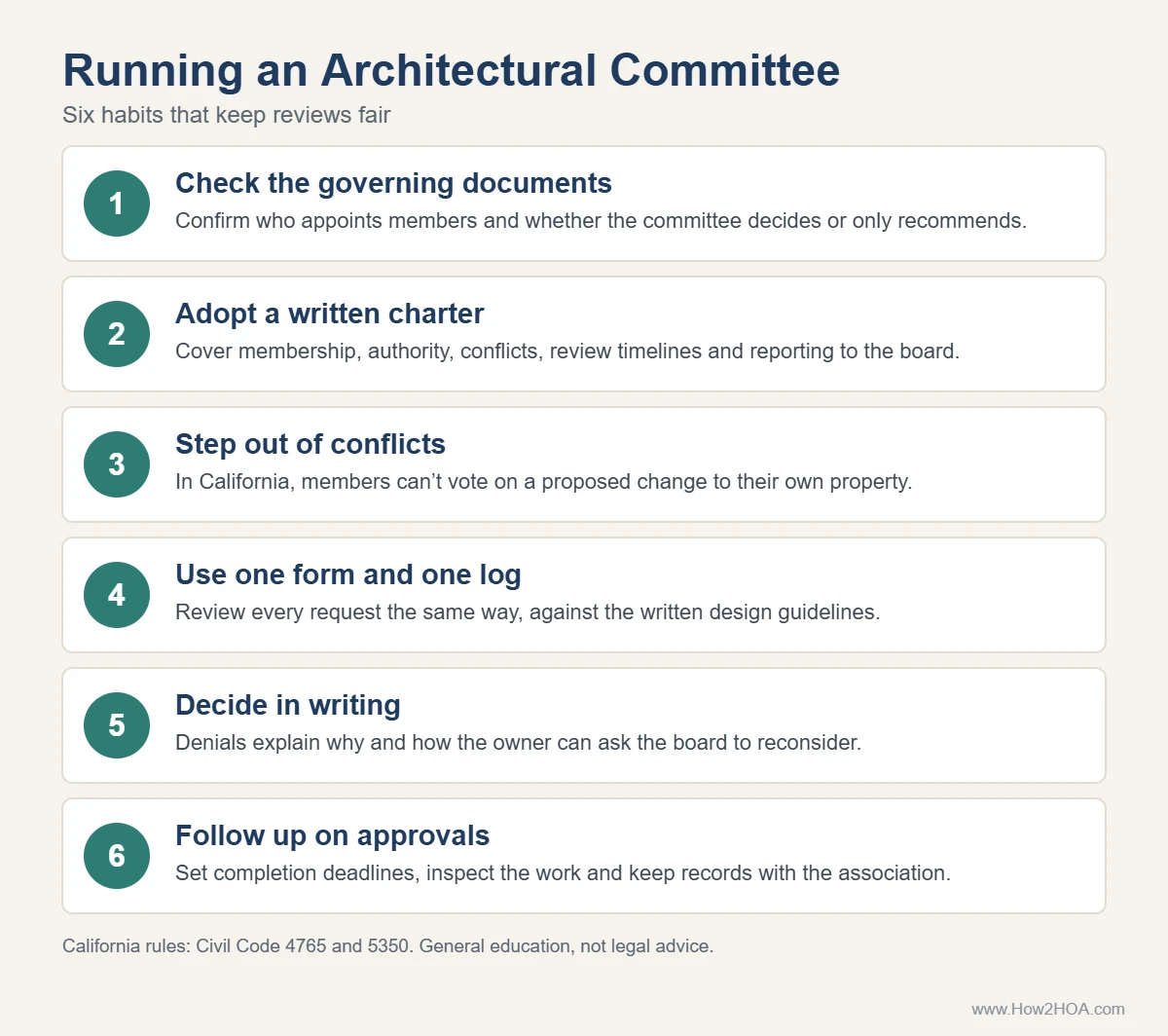
Share this infographic: Pinterest · Facebook · LinkedIn · Email · Download
Quick checklist
- Confirm the committee’s authority in the documents
- Adopt a written charter with conflict rules
- Use one form and one decision log
- Put every decision in writing, with reasons for denials
- Set completion deadlines and inspect finished work
- Store records with the association
Sources / The Law Behind This Page
- California Civil Code section 4765 (architectural review decisions)
- California Civil Code section 5350 (director and committee conflicts)
This article is general educational information, not legal advice. Your governing documents control many of these questions, so check with your association’s attorney about your situation.
Last reviewed November 2026. By the How2HOA Editorial Team.