
Sometimes one director becomes the problem: leaking confidential information, berating vendors, acting alone on behalf of the association or ignoring board decisions. Fellow directors often ask whether they can censure or remove that person. In California, the board’s options are narrower than most people expect. This guide explains what a censure is, what it can and cannot do and when removal is possible.
For the member-led recall process, see our full guide on how to recall an HOA board member. For everyday conflict between directors, see battling board members.
What a censure is
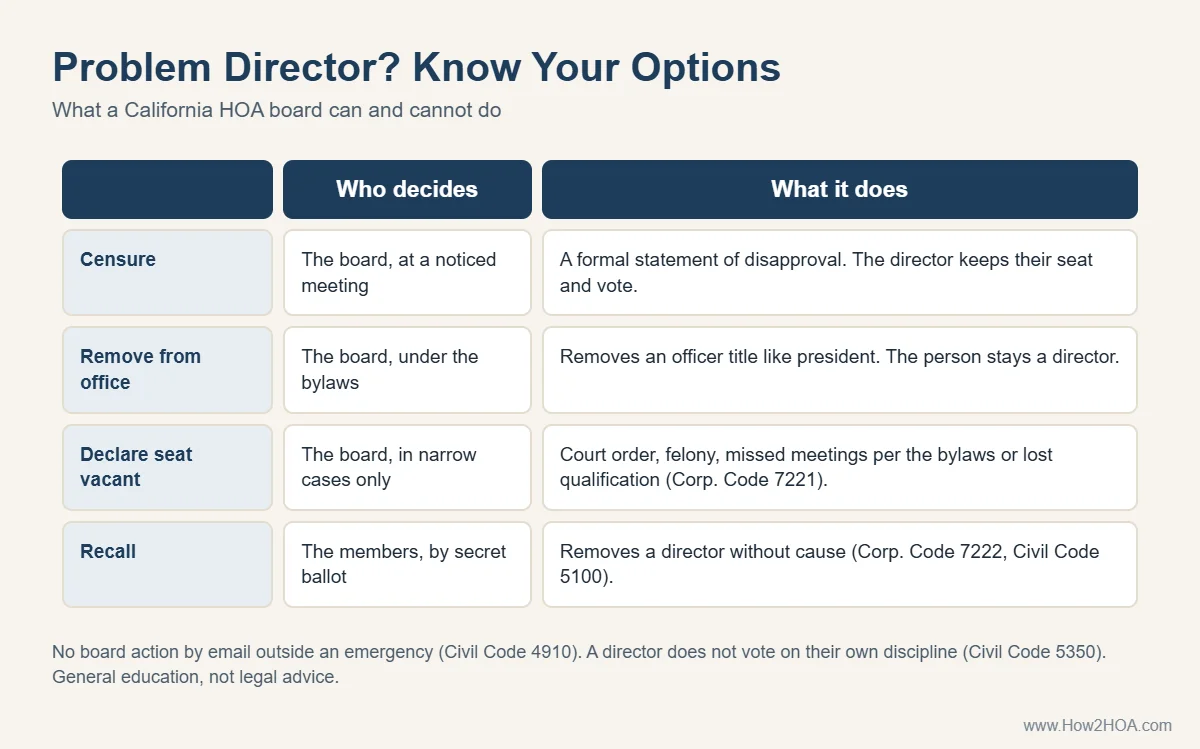
A censure is a formal statement by the board that a director’s conduct was improper. It is usually adopted as a resolution and recorded in the minutes.
No section of the Davis-Stirling Act creates or regulates censure of a director, so the board’s power to censure comes from its general authority to manage the association’s affairs and any code of conduct it has adopted. That has two practical effects:
- A censure is a statement, not a penalty. It does not remove the director, take away the director’s vote or bar the director from meetings or records.
- The process should be fair and careful. Because no statute sets the steps, a sloppy censure can create its own disputes, including claims of defamation or retaliation.
What the board cannot do to a fellow director
These limits come from California law:
- The board cannot vote a director off the board over a disagreement. Corporations Code section 7221 allows the board to declare a seat vacant only in narrow cases: a final court order declaring the director of unsound mind, a felony conviction, missing the number of meetings the bylaws specify (if that rule was in the bylaws when the director was elected) or failing to meet a qualification for office that was in effect at the start of the director’s term.
- Only the members can remove a director without cause. Removal without cause is approved by the members under Corporations Code section 7222, through a secret ballot vote (Civil Code section 5100).
- The board cannot act by email outside an emergency. Board business by email is generally not allowed except in an emergency when every director consents in writing (Civil Code section 4910). A censure discussed and agreed to in an email chain is not a valid board action.
- The director should not vote on their own discipline. A director may not vote on the discipline of that director (Civil Code section 5350). If your attorney treats a censure as discipline, the director who is the subject of the motion should not vote on it.
Boards can often remove a director from an officer position, such as president or treasurer, by board vote under the bylaws. The person remains a director. Check your bylaws before taking that step.
Before a censure: try the lighter tools first
As a good practice, a censure should come after other steps have failed:
- Talk directly. The president or a respected director raises the concern privately and specifically.
- Put expectations in writing. If the board has a code of conduct, point to the provisions at issue. If it does not, consider adopting one for all directors going forward.
- Get training. Board education on duties, confidentiality and open meeting rules often solves the problem. How2HOA’s free board training is a good place to start.
- Use a neutral. A facilitator or mediator can help when the conflict is personal.
- Involve the association’s attorney. Especially if the conduct involves confidential litigation matters, threats or possible breaches of fiduciary duty.
How to handle a censure if you go forward
If the board decides a censure is warranted, these good practices reduce risk:
- Get legal advice first. Ask the association’s attorney to review the facts, the wording and the meeting plan.
- Stick to documented facts. Describe specific conduct, dates and the rule or duty involved. Avoid opinions about character or motive.
- Give notice to the director. Tell the director in writing what conduct is at issue and give a real chance to respond before the vote.
- Choose the right session. Ask counsel whether the discussion belongs in executive session (Civil Code section 4935 allows certain matters, including member discipline and litigation, to be discussed there) and how the result should be reported in the minutes.
- Keep it on the agenda. Board action at a nonemergency meeting generally must be on the posted agenda.
- Keep it short. A brief resolution stating the conduct, the policy and the board’s expectation for the future is enough.
- Do not publicize it beyond what is required. Wider distribution adds risk and rarely helps the community.
When the conduct is serious
Some conduct goes beyond a censure:
- Misuse of association money or property. Contact the association’s attorney and insurance broker right away. Your fidelity and D&O coverage may come into play.
- Conflicts of interest. A director with a personal interest in a contract cannot vote on it, and the transaction is subject to Corporations Code sections 7233 and 7234 (Civil Code section 5350).
- Repeated missed meetings or lost qualifications. If the bylaws allow, the board may be able to declare the seat vacant under section 7221.
- Fraud, dishonesty or gross abuse of authority. The superior court can remove a director for fraudulent or dishonest acts or gross abuse of authority (Corporations Code section 7223). Talk with counsel.
- Loss of owner confidence. If owners want a director gone, the path is a recall vote by the members. See how to recall an HOA board member.
Advice for the director being censured
If you are the subject of a censure motion:
- Ask for the specific conduct and policy in writing.
- Respond calmly and in writing, and ask that your response be noted.
- Do not vote on the motion.
- Consider whether the concerns have merit. Many censures start with a fixable misunderstanding about board rules.
- If you believe the process is improper, consult your own attorney.

Share this infographic: Pinterest · Facebook · LinkedIn · Email · Download
Quick checklist for boards
- Talk privately and specifically first
- Point to a written code of conduct
- Offer training or mediation
- Get the attorney’s review before any censure
- Give the director notice and a chance to respond
- Act only at a properly noticed meeting, never by email
- Keep the subject director from voting on their own discipline
- Use facts, not opinions, in the resolution
- Remember that only the members can remove a director without cause
Sources / The Law Behind This Page
- California Corporations Code section 7221 (board vacating a seat)
- California Corporations Code section 7222 (removal by members)
- California Corporations Code section 7223 (court removal of a director)
- California Civil Code section 4910 (board action by email)
- California Civil Code section 4935 (executive session)
- California Civil Code section 5100 (secret ballot matters)
- California Civil Code section 5350 (director conflicts)
This article is general educational information, not legal advice. Your bylaws, code of conduct and the facts matter, so talk with your association’s attorney before censuring or removing any director.
Last reviewed November 2026. By the How2HOA Editorial Team.