
The benefits of a homeowners association come down to this: owners pool their money and follow shared rules so that the neighborhood’s common property is maintained, its amenities stay open, and problems have somewhere to go. In return, every owner pays assessments and gives up some freedom over their own property. Both halves are true, and a board that can explain both will have an easier time earning owners’ support.
Community associations are common. The Foundation for Community Association Research estimates there are about 373,000 community associations in the United States, home to roughly 78 million residents, according to its statistical review. If you serve on a board, you are a volunteer doing real work: budgets, meetings, vendor contracts and owner concerns. Below are six ways that work benefits the people who live in your community, followed by an honest look at what it costs them. If you are new to the subject, start with our beginner’s explainer on how a homeowners association works.
Six Benefits of a Homeowners Association

Share this infographic: Pinterest · Facebook · LinkedIn · Email · Download
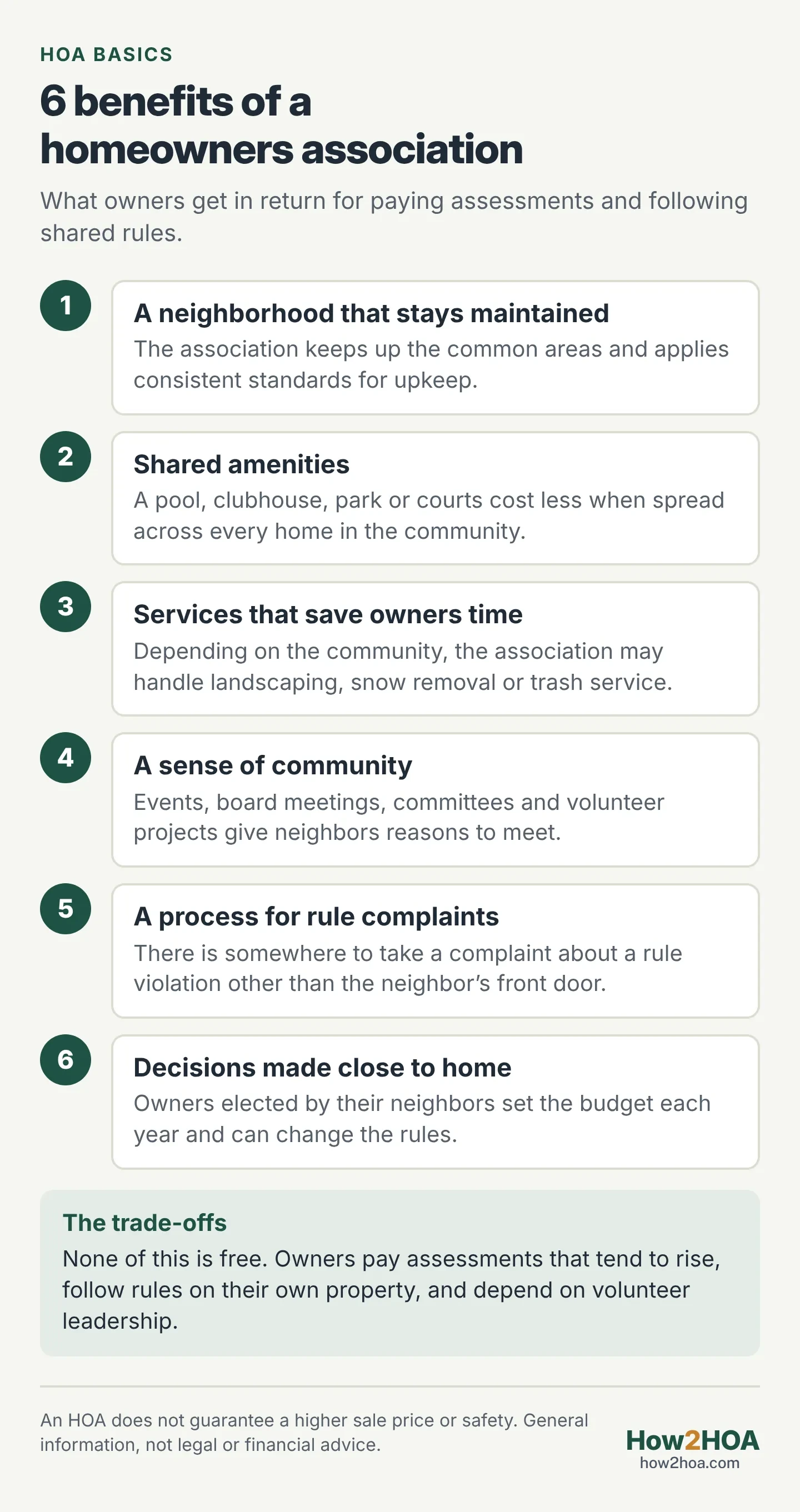
1. A Neighborhood That Stays Maintained
A home is one of the largest investments most owners will ever make, and they want it to hold its value. Buyers look at more than the house. They look at the street, the entrance, the landscaping and the condition of the homes next door.
This is where an association does its most visible work. The governing documents set standards for things like yard upkeep, exterior paint colors, and vehicles that sit unused in a driveway. The association maintains the common areas, and in communities with private streets it also looks after pavement, sidewalks and lighting. The result is a neighborhood that looks much the same in year 20 as it did in year one.
Be careful about promising owners a higher sale price, though. The research is mixed. An article in Cityscape, the research journal of the U.S. Department of Housing and Urban Development, summarized earlier studies this way: houses in HOAs tend to sell at a premium over houses outside them, with one Florida study putting the premium at around 7 percent, while a St. Louis-area study found the premium disappeared once finer differences between the homes were accounted for. An HOA does not guarantee a better price. What it can do is keep the common areas in good repair and the standards consistent, and those are things buyers notice.
2. Shared Amenities
Many associations own a pool, a clubhouse, a park, a playground or sports courts. Few owners could afford any of these alone. Together they can. The amenities are not free, because they are paid for through assessments, but owners usually do not pay each time they use them, and the cost is spread across every home in the community.
Owners also do not have to arrange the upkeep. The association handles routine maintenance, sets money aside in reserves for major repairs such as resurfacing the pool deck, and carries insurance on the common property so that storm or fire damage does not land on a few owners. Our article on what homeowners association insurance covers explains where the association’s policy stops and the owner’s begins.
3. Services That Save Owners Time
Depending on the community, the association may handle landscaping, snow removal, trash service, exterior painting or roof repair. An owner who travels often, or who simply does not want to mow a lawn, may value this more than any amenity. Because the association buys these services for the whole community, it can often negotiate one contract instead of dozens of owners hiring separately.
Some communities have gates or contract for a patrol service. Residents may like these features, but no association can promise safety, and a board should not describe a gate or a patrol as a guarantee.
4. A Sense of Community
Associations give neighbors reasons to meet. A summer barbecue, a holiday gathering or a cleanup day brings together people who live on opposite ends of the community and might never cross paths otherwise. Board meetings, committees and volunteer projects do the same thing in a different way. Owners who take part in decisions about their neighborhood tend to feel more connected to it.
5. A Process for Rule Complaints
Everyone who buys in the community is bound by the same governing documents. When an owner believes a neighbor is breaking a rule, for example with a dog that barks through the night or decorations left up for months, there is somewhere to take the complaint other than the neighbor’s front door. The association can look into it and, if there is a violation, follow its enforcement process. Our article on HOA rules and enforcing violations covers how that process works.
The limits matter here. An association enforces its own documents. It is not a referee for every disagreement between neighbors, and matters such as a property-line dispute are usually for the owners themselves or the local authorities to resolve.
6. Decisions Made Close to Home
Every neighborhood, with or without an HOA, is subject to city and county laws. An association adds a layer of private governance run by owners who are elected by their neighbors. Board members live in the community or own property there, so they see the same broken sprinkler and the same faded striping everyone else does.
That closeness has practical advantages. Rules can be written for one community’s needs and changed by its owners. The budget is set every year, and owners can see what their assessments pay for. An association with a funded reserve can also schedule major repairs on its own timetable instead of waiting for someone else’s budget cycle.
The Trade-Offs: Costs and Rules
None of these benefits is free, and an honest board says so.
- Assessments. Every owner pays regular assessments, and they tend to rise as costs rise. If reserves fall short of a major repair, owners may also face a special assessment. Falling behind can lead to late fees and collection action.
- Rules. Owners usually need approval before changing the outside of their home, and there may be limits on parking, pets, rentals and more. Breaking a rule can lead to a notice, a hearing and a fine.
- Volunteer leadership. An association is only as good as the people running it. A board that communicates poorly, enforces unevenly or underfunds reserves can turn every benefit above into a complaint.
For a buyer, the question is whether the benefits are worth the cost in this particular community. The answer is in the documents: the governing documents, the budget and the reserve study. Our article on what you need to know before you buy in an HOA lists what to read and what to ask.
How Boards Can Make the Benefits Visible
Owners notice the assessment every month. They notice the benefits only when someone points them out or when something breaks. A few habits help:
- Show where the money goes. A one-page budget summary in plain language does more than a 30-page financial report.
- Report finished work. When the pool is resurfaced or the entry landscaping is replaced, tell owners what was done and what it cost.
- Enforce rules the same way for everyone, including board members.
- Answer owners’ questions promptly, even when the answer is no.
For more on daily life in a community association, from buying and selling to getting along with neighbors, see our section on living in an HOA.
Sources
Other sources: Foundation for Community Association Research: Statistical Review · HUD Cityscape, Volume 16, Number 3
This article is general educational information, not legal or financial advice. Laws vary by state and your association’s governing documents control many of these questions, so check with your association’s attorney or another qualified professional about your situation.